On this page
- Rotary arm vs turntable stretch wrapper architectures and OEM benchmarks
- Centrifugal load stability physics: why tall light loads and 4,000+ lb beverage pallets fail on turntables
- 1. Centrifugal corner acceleration and the quadratic RPM² slip threshold
- 2. Four-archetype pallet load profile selection matrix
- Pallets per hour (PPH) throughput math: indexing, homing, and dual-carriage cycle budgets
- 1. Analytical cycle-time and film-revolution equations
- 2. Worked 16-revolution cycle budget: Conveyorized Turntable (14 RPM) vs Inline Rotary Arm (24–36 RPM)
- 250% powered pre-stretch carriage mechanics, corner compensation, and containment force
- 1. How 250% powered pre-stretch nip rollers work (3.5 : 1 elongation yield)
- 2. Electronic dancer-bar and proactive corner compensation across the 1.56× radius swing
- 3. Three-point containment force targets and stationary clamp/cut/roping subsystems
- Safety fencing, ISO 13855 light-curtain muting, and upstream pallet buffer handoffs
- 1. Why rotary arm perimeter guarding is larger and stricter than turntable guarding
- 2. Upstream pallet accumulation buffer sizing for film-roll replenishment stops
- 3. Five-point commissioning and site acceptance testing (FAT / SAT) checklist
- Technical basis and scope
Spinning an un-unitized pallet of empty PET bottles, paper towels, or stepped retail displays on a 15 RPM turntable—or indexing 2,000 kg beverage loads across a 4,000 lb slewing ring without accounting for the 5.5-second 0° roller homing delay—causes top-layer centrifugal slinging, corner flute crushing, premature turntable bearing failure, and palletizer discharge bottlenecks. A rotary arm stretch wrapper eliminates centrifugal load shift (0 N outward corner force) and turntable homing delays by holding the pallet stationary on a fixed heavy-duty conveyor while a counter-balanced overhead boom orbits the load at 15 to 36 RPM.
Select and integrate an automatic inline stretch wrapper by comparing rotary arm vs turntable stretch wrapper centrifugal corner physics (F_c = m × ω² × r_corner), modeling full Pallets Per Hour (PPH) cycle budgets including conveyor indexing and 0° turntable homing, specifying 250% powered pre-stretch nip-roller carriages (3.5 : 1 yield) with proactive corner compensation and base roping, and engineering ISO 13849-1 PL d perimeter fencing with ISO 13855 4-sensor sequential muting light curtains (S ≥ 1,650 mm).
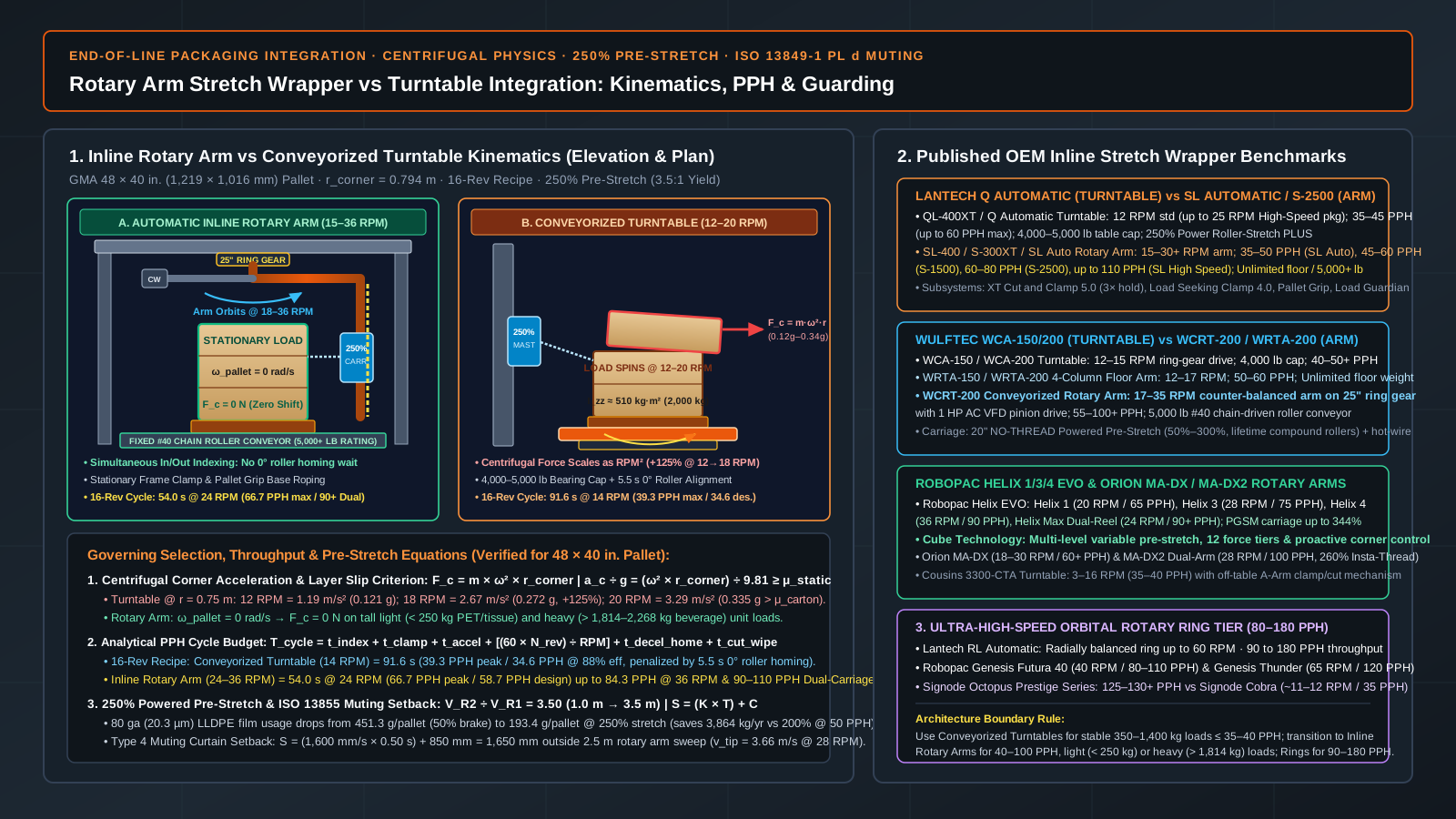
| Integration parameter | Conveyorized turntable stretch wrapper | Automatic inline rotary arm stretch wrapper | Operational boundary and failure prevented |
|---|---|---|---|
Load kinematics & centrifugal force (F_c) |
Pallet spins at 12–20 RPM (ω = 1.26–2.09 rad/s); a_c = 0.12g–0.34g at corners (r = 0.75 m) |
Pallet stays stationary (ω_pallet = 0 rad/s, F_c = 0 N); overhead boom orbits at 15–36 RPM |
Eliminates top-layer centrifugal slinging on light (< 250 kg), tall, or low-friction (μ = 0.12–0.20) loads |
Maximum unit load weight & inertia (I_zz) |
4,000–5,000 lbs (1,814–2,268 kg) dynamic slewing/caster cap; I_zz ≈ 510 kg·m² for 2,000 kg pallet |
5,000–6,000+ lbs static #40 chain roller rating (unlimited on floor-mounted straddle frames) |
Prevents slewing-ring bearing Brinelling and torsional bottom-layer shear on heavy beverage/masonry loads |
Conveyor indexing & 0° homing penalty |
Requires 5.5 s creep deceleration to precision 0° / 180° proximity switch to align turntable rollers |
Fixed straight-through conveyor (0 s homing wait); simultaneous infeed and outfeed pallet indexing |
Saves 6.5 to 11.5 s of non-wrapping dead time per pallet cycle |
| 16-revolution cycle time & sustained PPH | T_cycle = 91.6 s at 14 RPM → 39.3 PPH peak (25–45 PPH published design tier) |
T_cycle = 54.0 s at 24 RPM → 66.7 PPH peak (35–75+ PPH single arm; 90–110 PPH dual carriage) |
Prevents downstream wrapper bottlenecks behind robotic or layer palletizers running > 35 PPH |
Powered pre-stretch carriage (250% std) |
V_R2 ÷ V_R1 = 3.50 (1.0 m → 3.5 m yield); turntable clamp requires rotary air union or off-table arm |
V_R2 ÷ V_R1 = 3.50 (50%–344% range); clamp (XT 5.0 / Load Seeking 4.0) mounts on stationary frame |
Reduces 80 ga film usage from 451.3 g (50% brake) to 193.4 g/pallet (-57.1%) with zero rotary air leaks |
Guarding footprint & ISO 13855 muting |
Compact guarded zone (~2.8 × 2.8 m); rotating hazard confined to 1,500 mm turntable disc |
Full 4-sided 1,800–2,000 mm cage (~4.2 × 4.0 m) enclosing 2.5 m arm sweep (v_tip = 3.66 m/s at 28 RPM) |
Requires active arm bumper (≤ 15°–25° VFD brake stop) + Type 4 muting curtains set back S ≥ 1,650 mm |
Rotary arm vs turntable stretch wrapper architectures and OEM benchmarks
Once an end-of-line engineering review determines that a palletized load requires continuous multi-layer LLDPE film containment rather than—or in combination with—vertical plastic strapping (see our stretch wrap vs banding comparison inside the packaging line integration collection), the integrator must select the physical wrapping kinematics. In automated packaging lines, every automatic inline stretch wrapper belongs to one of three mechanical architectures:
- Automatic Conveyorized Turntable Stretch Wrapper (
Load Rotates, Film Mast Moves Vertically): The pallet indexes onto a powered roller or drag-chain conveyor section mounted atop a heavy-duty ring-gear slewing bearing or caster-supported turntable (1,300 to 1,524 mm/51 to 60 in.diameter). The entire turntable weldment and pallet spin at12 to 20 RPM(up to25 RPMon high-speed packages) while the film carriage climbs and descends a stationary vertical mast. When the wrap cycle completes, the turntable must decelerate to a precision0°(or180°) home position so its conveyor rollers align mechanically with the fixed upstream and downstream conveyors before the pallet can discharge. - Automatic Inline Rotary Arm Stretch Wrapper (
Pallet Stationary, Overhead Arm Orbits): Also termed a straddle wrapper, this architecture conveys the pallet along a continuous, non-rotating floor-mounted heavy-duty roller or chain conveyor (or stages it directly on the plant slab in fork-loaded straddle cells) and halts it at the wrap center. A counter-balanced steel boom (L-armcantilevered from a heavy column tower or suspended beneath a 2-post bridge or 4-column portal frame) rotates around the stationary pallet at15 to 36 RPMacross a2,200 to 2,850 mm (86 to 112 in.)swing diameter while the film carriage travels vertically along the rotating vertical leg of the arm. - Automatic Orbital Rotary Ring Stretch Wrapper (
Pallet Stationary, Balanced Ring Orbits and Elevates): On ultra-high-speed beverage, canning, tissue, and CPG lines requiring80 to 180 PPH, the film carriage (or twin opposing carriages) mounts directly onto a closed circular ring suspended inside a 4-column structural frame. Because a circular ring is radially balanced around its center of mass (eliminating the overhanging cantilever moment of an L-arm), the ring rotates at40 to 65 RPMwhile the entire ring frame elevates and lowers on synchronized drive belts.
| OEM & model series | Architecture type | Rotation speed (RPM) |
Published throughput (PPH) |
Maximum load weight rating | Pre-stretch, clamp, and containment subsystems |
|---|---|---|---|---|---|
Lantech Q Automatic & QL-400XT |
Conveyorized Turntable (Q Auto) / Semi-Auto Turntable (QL-400XT) |
12 RPM std (up to 25 RPM High-Speed pkg on Q Auto) |
30–40 PPH (QL-400XT); 35–45 PPH std (up to 60 PPH max on Q Auto) |
4,000–5,000 lbs (1,814–2,268 kg) turntable rating |
250% std Power Roller-Stretch PLUS / Metered Film Delivery; XT Cut and Clamp / Load Seeking Clamp 4.0; Pallet Grip; Load Guardian |
Lantech SL Automatic, S-1500 / S-2500 & SL High Speed |
Automatic Inline Rotary Arm (Straddle / Overhead Tower) |
15 RPM std (S-300XT / SL-400 / SL Auto); 18–30+ RPM (S-2500 / SL High Speed) |
35–50 PPH (SL Auto); 45–60 PPH (S-1500); 60–80 PPH (S-2500); up to 110 PPH (SL High Speed) |
5,000+ lbs static conveyor rating (Unlimited on floor-mounted S-300XT / SL-400) |
200%–250% std (100%–300% range); stationary XT Cut and Clamp 5.0 (3× holding force) / Load Seeking Clamp 4.0; Pallet Grip roping |
Wulftec WCA-150 / WCA-200 vs WCRT-200 / WRTA-200 |
Conveyorized Turntable (WCA) vs Conveyorized (WCRT) / 4-Post Floor (WRTA) Rotary Arm |
WCA: 12–15 RPM table; WRTA: 12–17 RPM arm; WCRT-200: 17–35 RPM arm (25 in. ring gear + pinion) |
WCA: 40–50 PPH; WRTA: 50–60 PPH; WCRT-200: 55–100+ PPH |
WCA: 4,000 lbs; WCRT-200: 5,000 lbs (#40 chain rollers); WRTA: Unlimited (floor) |
20 in. NO-THREAD Powered Pre-Stretch Carriage (200% preset, 50%–300% range, lifetime compound rollers); pneumatic clamp, impulse hot-wire cut & brush wipe |
Robopac Helix 1 / 3 / 4 EVO & Helix Max |
Automatic Inline Rotary Arm (Single or Dual-Reel Carriage) |
Helix 1: 20 RPM; Helix 3: 28 RPM; Helix 4: 36 RPM (Helix Max: 24 RPM dual-reel) |
Helix 1: 65 PPH; Helix 3: 75 PPH; Helix 4 / Max: 90+ PPH |
Static conveyor capacity (4,400–5,500 lbs / 2,000–2,500 kg) |
PGSM / PGSU motorized pre-stretch (up to 344%) with Cube Technology (multi-level pre-stretch, 12 containment force tiers, proactive corner compensation) |
Orion MA-DX / MA-DX2 & Cousins 3300-CTA / A-Arm |
4-Leg Automatic Rotary Arm (Orion MA-DX) vs Conveyorized Turntable (Cousins 3300-CTA) |
Cousins 3300-CTA: 3–16 RPM table; Orion MA-DX: 18–30 RPM arm (MA-DX2: 28 RPM dual arm) |
Cousins 3300-CTA: 35–40 PPH; Orion MA-DX: 60+ PPH (MA-DX2 dual carriage: up to 100 PPH) |
4,000–6,000 lbs conveyorized (Unlimited on non-conveyorized MA-DX) |
Orion: 260% standard Insta-Thread powered pre-stretch with IntelleVue HMI; Cousins: off-turntable A-Arm film clamp/cut |
Rotary Ring Tier (Lantech RL Auto, Robopac Genesis Futura / Thunder, Signode Octopus) |
Automatic Elevating Orbital Ring Wrapper (vs Signode Cobra 12 RPM / 35 PPH) |
Futura 40: 40 RPM; Lantech RL: 60 RPM; Genesis Thunder: 65 RPM |
Futura: 80–110 PPH; Thunder: 120 PPH; Signode Octopus: 125–130+ PPH; Lantech RL: 90–180 PPH |
Stationary conveyor rating (zero rotating load or cantilever arm moment) |
250%–300% cordless or servo direct-drive pre-stretch without sliding slip-ring contacts (Genesis Thunder); integrated top-sheet dispensers |
Key takeaway: Match the wrapper architecture to line rate and unit-load physics—use conveyorized turntables (Lantech Q Automatic, Wulftec WCA-150/200, Cousins 3300-CTA) for uniform, mid-weight pallets up to 35–45 PPH, specify an inline rotary arm stretch wrapper (Lantech SL Automatic / S-2500, Wulftec WCRT-200, Robopac Helix EVO, Orion MA-DX) for 40–100+ PPH or whenever loads are light (< 250 kg), fragile, mixed-SKU, or heavy (> 1,814–2,268 kg), and step up to orbital rotary rings (Lantech RL, Robopac Genesis, Signode Octopus) for 90–180 PPH bottling and tissue lines.
Centrifugal load stability physics: why tall light loads and 4,000+ lb beverage pallets fail on turntables
As documented in Lantech’s turntable vs straddle engineering analysis, the fundamental physical divide in a rotary arm vs turntable stretch wrapper evaluation is whether the un-unitized product must survive rotational acceleration before the stretch film web locks the layers together.
1. Centrifugal corner acceleration and the quadratic RPM² slip threshold
When a conveyorized turntable rotates a rectangular pallet at angular speed RPM, every carton located at radial distance r from the turntable spin axis experiences an outward centrifugal force F_c:
ω = (2 × π × RPM) ÷ 60
r_corner = 0.5 × √(L_pallet² + W_pallet²)
F_c = m_unit × ω² × r_corner
a_c ÷ g = (ω² × r_corner) ÷ 9.81 ≥ μ_static (layer slip threshold)
Where:
RPM: Turntable rotational velocity (12 to 20 RPMon standard automatic turntables; up to25 RPMon high-speed options).ω: Angular velocity in radians per second (1.257 rad/sat12 RPM,1.571 rad/sat15 RPM,1.885 rad/sat18 RPM, and2.094 rad/sat20 RPM).r_corner: Radial distance from the pallet center to the outer pallet corner (m). Using the diagonal envelope formula from our palletization calculator guide, a standard48 × 40 in. (1,219 × 1,016 mm)GMA pallet has diagonalD_diag = √(1.219² + 1.016²) = 1.587 m (62.5 in.), givingr_corner = 0.7935 m (31.2 in.)at the extreme corner andr ≈ 0.75 mat the center of mass of an outer top-corner case or bottle cluster.μ_static: Static coefficient of friction between stacked layers (μ = 0.25 to 0.35for dry Kraft corrugated shippers, dropping toμ = 0.12 to 0.20for UV-varnished retail display cartons, shrink-wrapped beverage trays, HDPE containers, bulk PET bottles on polypropylene tier sheets, or condensation-damp cold-storage cases).
Worked comparison 1: Top-corner case slinging at 12 RPM vs 18 RPM vs 20 RPM
Evaluate an un-wrapped top-tier corner carton sitting at r = 0.75 m atop a 2,100 mm (82.7 in.) pallet during the first 15 to 25 seconds of the wrap cycle, before the rising film carriage reaches the upper layers:
- At
12 RPM(ω = 1.257 rad/s):- Outward radial acceleration is
a_c = 1.257² × 0.75 = 1.185 m/s²(0.121 g). - Vector-summed with tangential acceleration during turntable ramp-up (
α × r ≈ 0.45 m/s²), resultant horizontal acceleration reaches0.14 to 0.16 g, which already equals the sliding threshold (μ = 0.12 to 0.18) of glossy shrink-wrapped beverage trays, waxed produce boxes, and tall empty PET bottle layers.
- Outward radial acceleration is
- At
18 RPM(ω = 1.885 rad/s):- Outward radial acceleration jumps to
a_c = 1.885² × 0.75 = 2.665 m/s²(0.272 g). - Rule of thumb (
Quadratic RPM² Penalty): Because centrifugal force scales with the square of rotational speed (RPM²), increasing turntable speed by50%(from 12 to 18 RPM) increases outward corner slinging force by2.25×(+125%), slinging top cases outward before the film web ever locks the top tier.
- Outward radial acceleration jumps to
- At
20 RPM(ω = 2.094 rad/s):- Radial acceleration reaches
a_c = 2.094² × 0.75 = 3.290 m/s²(0.335 g), exceeding the static friction of even dry Kraft corrugated board (μ ≈ 0.30) on column-stacked loads (see our warehouse palletization patterns and stability guide for column vs interlocked shear limits).
- Radial acceleration reaches
Worked comparison 2: Rotational moment of inertia (I_zz) on a 2,000 kg beverage pallet
Now evaluate a heavy M = 2,000 kg (4,409 lb) bottled beverage, canned food, or masonry pallet (1.219 × 1.016 m) resting on a 350 kg conveyorized turntable weldment:
I_pallet = (1 ÷ 12) × M × (L_pallet² + W_pallet²)
- Pallet rotational inertia:
I_pallet = (1 ÷ 12) × 2,000 kg × (1.219² + 1.016²) = 166.67 × 2.518 = 419.7 kg·m². Adding~90.3 kg·m²for the steel turntable and powered roller deck yields a total rotating inertia ofI_zz ≈ 510 kg·m². - Torsional shear and bearing wear: Accelerating or decelerating
510 kg·m²between0and15 RPM(1.571 rad/s) int_ramp = 2.5 s(α = 0.628 rad/s²) appliesT = I_zz × α = 320.3 N·mof torsional shear across the wooden pallet stringers and bottom carton flaps. Worse, creeping510 kg·m²of live mass into an exact0°home stop every75 secondshammers the slewing-ring pinion and support casters under2+ metric tonsof vertical load. - How the rotary arm eliminates both failure modes: On a rotary arm stretch wrapper, pallet angular velocity is identically
ω_pallet = 0 rad/s(F_c = 0 NandI_pallet_rot = 0 kg·m²). Only the counter-balanced overhead steel boom and film carriage (~180 to 280 kg) rotate on a sealed overhead25 in. (635 mm)ring-gear slewing bearing (Wulftec WCRT-200/Lantech SL Automatic).
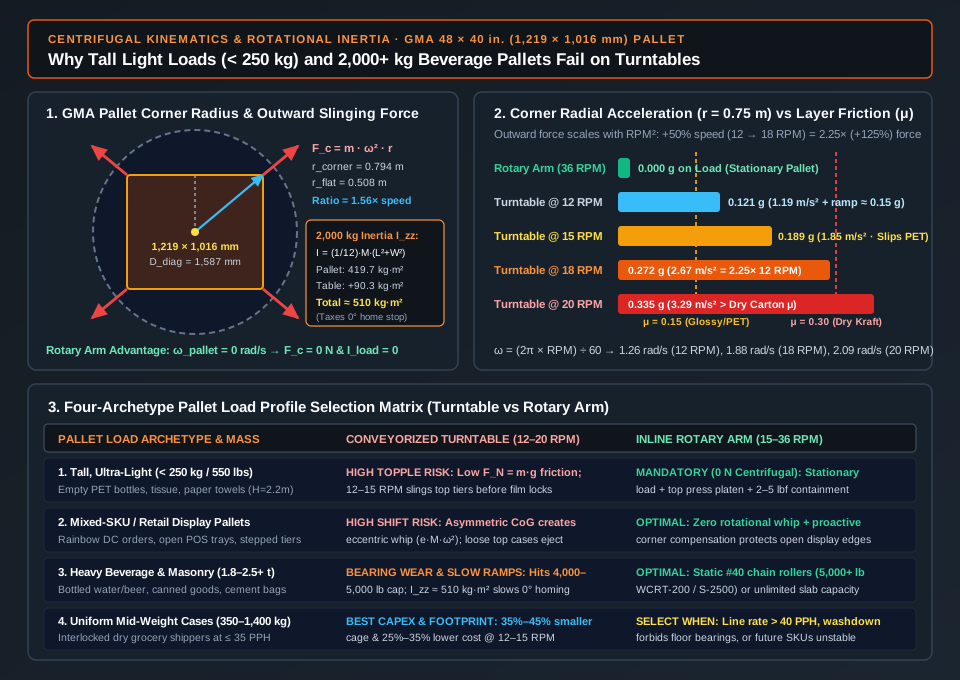
2. Four-archetype pallet load profile selection matrix
| Pallet load archetype & geometry | Conveyorized turntable behavior (12–20 RPM) |
Automatic inline rotary arm behavior (15–36 RPM) |
|---|---|---|
1. Tall, ultra-light, un-shingled loads (< 250 kg / 550 lbs, height 1.8–2.4 m)Bulk empty PET/HDPE bottles on tier sheets, tissue & paper towels, empty cans |
High topple & slinging risk: Low normal force (F_N = m × g) produces minimal inter-layer friction; 12–15 RPM rotation slings upper tiers outward before the carriage climbs the mast |
Mandatory (0 N centrifugal force): Pallet remains completely stationary on the conveyor while the arm wraps upward; electric/pneumatic top platen (top press) stabilizes the top layer against film pull |
| 2. Mixed-SKU order-picked & club-store display pallets Retail DC rainbow pallets, stepped layers, open-face point-of-sale ( POS) trays |
High eccentric shift risk: Off-center center of mass creates an overturning whip moment (e × M × ω²); loose small cartons on top corners eject during turntable ramp-up |
Optimal: Stationary pallet eliminates eccentric rotational whip; proactive corner compensation (Robopac Cube Technology / Lantech Load Guardian) prevents crushing open display edges |
3. Heavy beverage, canned goods & masonry loads (1,800–2,500+ kg / 4,000–5,500+ lbs)Bottled water/beer cases, paint pails, bagged cement, industrial batteries |
Bearing wear & cycle penalty: Approaches or exceeds 4,000–5,000 lb dynamic slewing-ring rating; 510 kg·m² inertia forces slow 3.5–5.0 s ramps and taxes 0° roller alignment homing |
Optimal: Load mass rests statically on fixed floor conveyor frames (Wulftec WCRT-200 5,000 lb #40 chain rollers) or directly on the concrete slab (unlimited weight on floor-mounted WRTA / SL-400) |
4. Uniform, mid-weight interlocked case pallets (350–1,400 kg / 770–3,100 lbs) at ≤ 35 PPHDry grocery corrugated shippers, high-friction shrink bundles |
Best CAPEX & footprint value: 35%–45% smaller guarded floor footprint than a rotary arm, 25%–35% lower capital cost, and reliable 30–45 PPH output at 12–15 RPM |
Select only when: Line throughput exceeds 40 PPH, washdown/pit hygiene prohibits floor turntable bearings, or future SKU expansion introduces unstable loads |
Key takeaway: Never spin a unit load whose inter-layer friction (μ_static) is approached by a_c ÷ g = (ω² × r_corner) ÷ 9.81 or whose mass exceeds 1,814 kg (4,000 lbs) on a high-duty cycle—specify a rotary arm stretch wrapper so ω_pallet = 0 rad/s eliminates centrifugal slinging and rotational inertia shock altogether.
Pallets per hour (PPH) throughput math: indexing, homing, and dual-carriage cycle budgets
Catalog brochure speeds (RPM) never convert directly into Pallets Per Hour (PPH) because non-wrapping overhead—conveyor indexing through the muting curtains, acceleration/deceleration ramps, turntable 0° roller alignment homing, and automatic film clamp/cut/wipe—consumes 25% to 40% of total cycle time.
1. Analytical cycle-time and film-revolution equations
Calculate total cycle time (T_cycle, in seconds), required film revolutions (N_rev), and design line throughput (PPH_design) using:
N_rev = N_bottom + [(H_load ÷ [W_film_eff × (1 − O_overlap)]) × 2] + N_top
T_cycle = t_index_in + t_clamp + t_accel + [(60 × N_rev) ÷ RPM_steady] + t_decel_home + t_cut_wipe + t_index_out
PPH_max = 3,600 ÷ T_cycle | PPH_design = (3,600 ÷ T_cycle) × η_line
Where η_line ≈ 0.85 to 0.90 accounts for film roll changes and upstream/downstream transfer handshakes (when matching wrapper throughput to a robotic cell such as our FANUC CRX-30iA cobot palletizer integration).
2. Worked 16-revolution cycle budget: Conveyorized Turntable (14 RPM) vs Inline Rotary Arm (24–36 RPM)
Evaluate a standard 48 × 40 in. (1,219 × 1,016 mm) pallet with wrap height H_load = 1,650 mm (65 in.), wrapped with a 20 in. (508 mm) film roll (necked-down effective web width W_film_eff ≈ 430 mm / 17 in. at 250% pre-stretch) using a 50% spiral overlap (up + down double spiral = [1,650 ÷ (430 × 0.50)] ≈ 8 spiral revolutions), N_bottom = 5 base-locking wraps (with Pallet Grip roping), and N_top = 3 top-locking wraps. Total film revolutions equal N_rev = 5 + 8 + 3 = 16 revolutions.
| Cycle phase | Case A: Conveyorized Turntable (14 RPM avg) |
Case B: Inline Rotary Arm (24 RPM / 36 RPM) |
Mechanical root cause of time delta |
|---|---|---|---|
1. Conveyor index in/out (t_index) |
8.0 s (overlapped in/out across turntable split gap; 14.0 s if sequential) |
6.5 s (simultaneous continuous straight-through indexing) |
Fixed conveyor inside rotary arm frame transfers wrapped and queued pallets together without crossing a rotary table gap |
2. Clamp close & ramp-up (t_clamp + t_accel) |
4.5 s (3.5 s gentle soft-start ramp to prevent loose top-layer shift) |
2.0 s (counter-balanced steel boom accelerates without moving pallet) |
Stationary pallet on rotary arm eliminates product inertia during VFD ramp-up |
3. Steady-state wrapping (16 revolutions) |
68.6 s at 14 RPM (80.0 s at 12 RPM) |
40.0 s at 24 RPM (34.3 s at 28 RPM; 26.7 s at 36 RPM) |
Overhead ring-gear arm orbits 1.7× to 2.6× faster than a loaded turntable can spin without slinging cartons |
4. Deceleration & 0° roller homing (t_decel_home) |
5.5 s (must creep to exact 0°/180° proximity switch to align conveyor rollers) |
2.0 s (VFD dynamic-braking stop at clamp park position; zero roller homing) |
Critical turntable penalty: turntable rollers must align within ±3 mm of fixed exit conveyor before transfer |
5. Automatic clamp, cut & tail wipe (t_cut_wipe) |
5.0 s (rotary pneumatic union actuation + brush/platen wipe) |
3.5 s (stationary conveyor-frame clamp + impulse hot-wire cut & wipe) |
Stationary-frame clamp/cut actuator operates with direct manifold air and shorter stroke |
Total cycle time (T_cycle) |
91.6 s (97.6 s non-overlapped) |
54.0 s at 24 RPM (42.7 s at 36 RPM Helix 4 EVO) |
Rotary arm saves 37.6 to 48.9 seconds per pallet (-41% to -53% cycle time) |
Peak & design throughput (PPH) |
39.3 PPH peak / 34.6 PPH design (@ 88% eff.; 25–45 PPH range) |
66.7 PPH peak / 58.7 PPH design (@ 24 RPM); 84.3 PPH peak / 74.2 PPH design (@ 36 RPM) |
Dual-carriage rotary arms (Orion MA-DX2, Robopac Helix Max, Lantech SL High Speed) apply 2 webs/rev (8 rev = 16 layers) to reach 90–110 PPH |
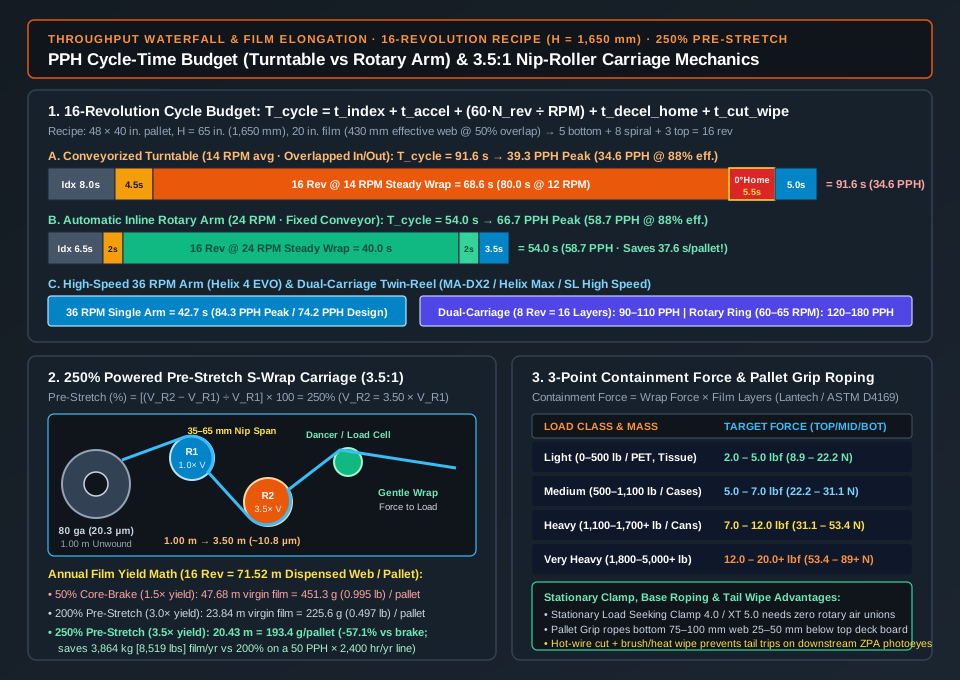
Key takeaway: Budget at least 23.0 s of non-wrapping overhead (indexing + soft-start + 5.5 s 0° roller homing + cut/wipe) on every conveyorized turntable cycle (limiting realistic 16-rev sustained output to 30–40 PPH), and transition to an inline rotary arm stretch wrapper (14.0 s overhead, 58–74+ PPH single-carriage or 90–110 PPH dual-carriage) whenever line rates exceed 35–40 PPH.
250% powered pre-stretch carriage mechanics, corner compensation, and containment force
Stretch film does not unitize a pallet by clinging passively; it acts as an elastic band whose inward restoring tension (Wrap Force) multiplied by the number of overlapping film layers produces Containment Force (Lantech containment force methodology).
1. How 250% powered pre-stretch nip rollers work (3.5 : 1 elongation yield)
Inside a powered pre-stretch carriage (Lantech Power Roller-Stretch PLUS / Metered Film Delivery, Wulftec 20 in. NO-THREAD Powered Pre-Stretch Carriage, Robopac PGSM / PGSU, Orion 260% Insta-Thread), the 20 in. (508 mm) Linear Low-Density Polyethylene (LLDPE, typically 63 to 90 gauge / 16.0 to 22.9 µm) film web threads in an S-wrap path around two high-friction elastomer-coated steel nip rollers (Roller 1 and Roller 2) geared at a fixed ratio or driven by twin servo motors:
Pre-Stretch (%) = [(V_R2 − V_R1) ÷ V_R1] × 100 | Elongation Yield Ratio = 1 + [Pre-Stretch (%) ÷ 100]
- At
250%powered pre-stretch (Elongation Yield Ratio = 3.50 : 1): Exit rollerRoller 2rotates at3.50×the surface tangential velocity of entry rollerRoller 1(V_R2 ÷ V_R1 = 3.50). Every1.00 m (39.4 in.)of virgin80 ga (20.3 µm)film unwound from the roll is elongated inside the narrow35 to 65 mm (1.4 to 2.5 in.)free-span nip gap between the rollers into3.50 m (137.8 in.)of dispensed film (thinning the web to ~10.8 µmwhile keeping width neck-down under12%–16%). - Why pre-stretch must occur inside the nip rollers—never against the pallet corners: On a mechanical core-brake carriage, the pallet corners themselves must pull
35 to 50 lbfof tension to stretch the film, which crushes corrugated vertical flutes and drags light cartons off the stack. In a250%powered pre-stretch carriage, the carriage motor supplies the40 to 60 lbfyield work inside the roller nip and pays out the pre-elongated film toward the pallet at a separately controlled, gentle Force-to-Load (Wrap Force).
Worked film-consumption and annual resin savings calculation (50 PPH line)
Wrapping a 1,219 × 1,016 mm GMA pallet (perimeter P_pallet = 2 × [1.219 + 1.016] = 4.470 m) for 16 revolutions requires L_dispensed = 16 × 4.470 m = 71.52 m (234.6 ft) of stretched film around the load. For 20 in. (0.508 m) wide, 80 ga (20.3 µm) LLDPE film (density ρ = 0.918 g/cm³), un-stretched linear mass is 0.508 m × 20.3×10⁻⁶ m × 918,000 g/m³ = 9.465 g/m:
- At
50%core-brake stretch (1.5×yield): Consumes71.52 ÷ 1.50 = 47.68 mvirgin film =451.3 g (0.995 lbs)per pallet. - At
200%powered pre-stretch (3.0×yield): Consumes71.52 ÷ 3.00 = 23.84 mvirgin film =225.6 g (0.497 lbs)per pallet (50.0%film reduction vs core brake). - At
250%powered pre-stretch (3.5×yield): Consumes71.52 ÷ 3.50 = 20.43 mvirgin film =193.4 g (0.426 lbs)per pallet (57.1%reduction vs core brake, and14.3%additional savings [32.2 g/pallet] vs200%pre-stretch). Across a50 PPHline operating2,400 hrs/yr(120,000 pallets/yr), stepping from200%to250%pre-stretch saves3,864 kg (8,519 lbs)of LLDPE film per year.
2. Electronic dancer-bar and proactive corner compensation across the 1.56× radius swing
Because a 48 × 40 in. (1,219 × 1,016 mm) pallet is rectangular, the radial distance from the spin center to the film contact line oscillates four times per revolution between the flat-side radius (r_min = 508 mm) and the diagonal corner radius (r_corner = 793.5 mm). That r_corner ÷ r_min = 1.56× geometry ratio causes linear film demand speed to spike by +56% as each corner approaches and plummet immediately after the corner passes. Without rapid payout modulation, corner tension spikes and buckles the vertical corrugated walls that carry 60% to 70% of top-to-bottom Box Compression Test (BCT) strength.
Specify either electronic dancer-bar / load-cell closed-loop tension control (Wulftec NO-THREAD / Lantech Power Roller-Stretch PLUS), which senses web tension on an instrumented dancer roller and modulates the carriage VFD within milliseconds, or proactive ultrasonic/profile corner compensation (Robopac Cube Technology / Lantech Metered Film Delivery & Load Guardian), which pre-accelerates the film payout motor just before each corner contacts the web.
3. Three-point containment force targets and stationary clamp/cut/roping subsystems
Per Lantech’s 3-point containment force specification, verify inward film restraint at Top (6 in. / 150 mm below top edge), Middle (mid-height), and Bottom (6 in. / 150 mm above pallet deck) using a calibrated pull-plate gauge (Containment Force Tool):
| Load classification & unit mass | Target 3-point containment force (lbf / N) |
Recommended wrapper & carriage recipe |
|---|---|---|
1. Light & fragile loads (0–500 lbs / 0–227 kg)Empty PET/glass bottles, bulk tissue, paper towels, light chipboard trays |
2.0 to 5.0 lbf (8.9 to 22.2 N)(zero corner flute crushing) |
Inline Rotary Arm mandatory (15–24 RPM) + 250% pre-stretch + proactive corner compensation + low wrap force + overhead top platen (top press) |
2. Medium / standard case loads (500–1,100 lbs / 227–500 kg)Dry grocery corrugated shippers, shrink-wrapped cased goods |
5.0 to 7.0 lbf (22.2 to 31.1 N)(uniform within ±1.0 lbf Top/Mid/Bot) |
Conveyorized Turntable (≤ 35–40 PPH) or Rotary Arm (> 40 PPH); 250% pre-stretch; 4–5 bottom wraps with base roping (Pallet Grip) + 50% overlap |
3. Heavy loads (1,100–1,700+ lbs / 500–770+ kg)Beverage cases, canned food, bottled sauces, hardware cartons |
7.0 to 12.0 lbf (31.1 to 53.4 N) |
Rotary Arm preferred (or ring-gear turntable ≤ 12 RPM); 250%–300% pre-stretch; multi-level force (Cube Technology applying higher force at base/middle) |
4. Very heavy, tall, or unstable loads (1,800–5,000+ lbs / 816–2,268+ kg)Glass beverage pallets, pails, bagged cement/resin, column stacks |
12.0 to 20.0+ lbf (53.4 to 89.0+ N)(qualified to ASTM D4169 / ISTA 3E) |
Rotary Arm (Wulftec WCRT-200 / Lantech S-2500 / Robopac Helix) or Rotary Ring; 80–90 ga film at 250%–300% pre-stretch + roped base cable (or combined strapper-wrapper) |
Three mechanical subsystems complete the unmanned inline cycle:
- Stationary-frame film clamping (
Lantech XT Cut and Clamp 5.0 / Load Seeking Clamp 4.0,Wulftec Pneumatic Jaw Clamp): On a conveyorized turntable, the clamp sits on the spinning table perimeter (requiring a rotary pneumatic slip union that wears over time, unless equipped with an off-table device such asCousins A-ArmorLantech Load Seeking Clamp). On a rotary arm stretch wrapper, the clamp assembly bolts directly to the stationary conveyor frame (zero rotary air unions), whereLoad Seeking Clamp 4.0travels laterally to grip the pallet side regardless of width variation (providing 3× conventional holding force). - Base roping (
Lantech Pallet Grip/ pneumatic roping bar): To prevent a unitized load block from sliding off its wooden pallet during forklift stops or truck dock impacts, a rising guide roller gathers the bottom3 to 4 in. (75 to 100 mm)of the film web into a tight horizontal cable and drives it25 to 50 mm (1 to 2 in.)below the top deck board of the pallet—leaving the 2-way/4-way fork pockets completely clear (cross-check pallet deck and stringer geometry in our pallet dispenser machine magazine sizing guide). - Impulse hot-wire / blade cut and tail wipe: Loose trailing film tails block downstream photoeyes (triggering false
6.0 sslug jam lockouts on zero pressure accumulation conveyors). At cycle completion, an impulse nichrome hot-wire or serrated knife severs the tensioned web while a pneumatic brush platen, vacuum blower, or ultrasonic/heat-seal pad wipes the tail flat against the load side.
Key takeaway: Specify a 250% powered pre-stretch carriage (3.5 : 1 yield, saving 57.1% film vs core-brake and 3,864 kg/yr vs 200% stretch at 50 PPH) with proactive corner compensation, qualify containment force at Top, Middle, and Bottom (2–5 lbf light, 5–7 lbf medium, 7–20+ lbf heavy), and lock the bottom film cable 25–50 mm below the top pallet deck board without obstructing fork tine entry.
Safety fencing, ISO 13855 light-curtain muting, and upstream pallet buffer handoffs
Integrating an automatic inline stretch wrapper into a production line requires coordinating both ISO 13849-1 (Performance Level d, Category 3 minimum) machine guarding (ANSI/PMMI B155.1, EN 415-6, OSHA 29 CFR 1910.212) and upstream conveyor accumulation buffering.
1. Why rotary arm perimeter guarding is larger and stricter than turntable guarding
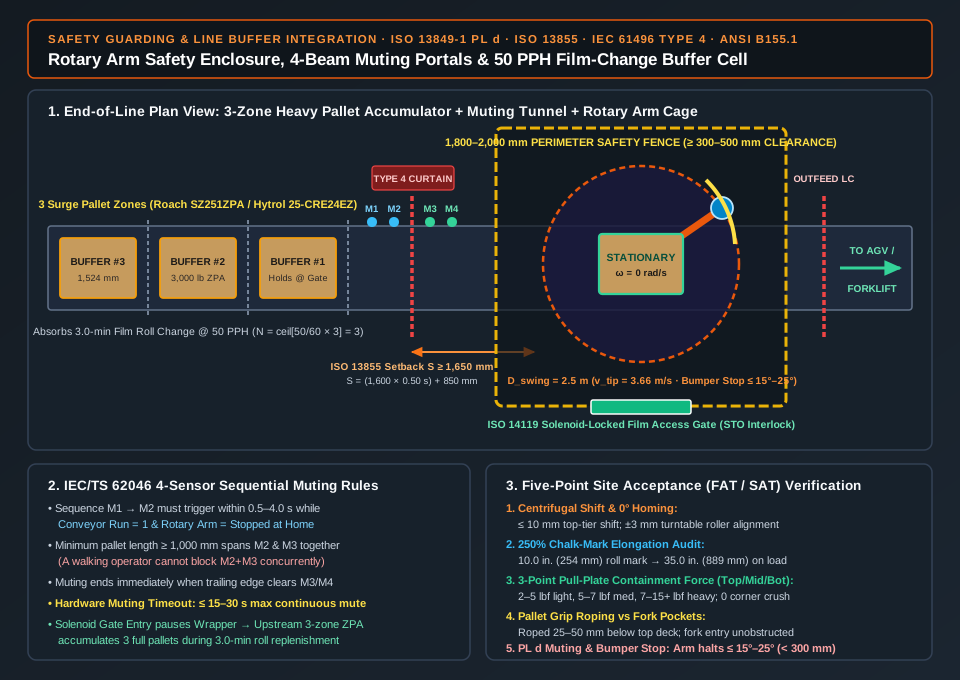
On a turntable wrapper, rotational motion is confined within the 1,500 mm (59 in.) turntable disc. On a rotary arm stretch wrapper, the overhead steel boom and vertical mast sweep a D_swing = 2,200 to 2,850 mm (86 to 112 in.) diameter circle at 15 to 36 RPM. At 28 RPM on a D_swing = 2.50 m arm (Robopac Helix 3 EVO / Wulftec WCRT-200 / Orion MA-DX), the outer carriage travels at a tangential tip speed of:
v_tip = π × D_swing × (RPM ÷ 60) = π × 2.50 m × (28 ÷ 60) = 3.66 m/s (720 FPM / 8.2 mph)
To safeguard this 3.66 m/s sweeping hazard, every inline rotary arm installation requires a four-layer safety architecture:
- Perimeter wire-mesh safety enclosure (
ISO 13857): Welded steel mesh panels (≥ 1,800 to 2,000 mm/71 to 79 in.high) must enclose all four sides of the cell (typical guarded footprint 3,800 × 3,800 mm to 4,800 × 4,200 mm) with at least300 to 500 mm (12 to 20 in.)of internal clearance outside the maximum radial path of the rotating arm to eliminate shear/pinch traps. Film-threading access doors require dual-channel safety interlock switches (ISO 14119) with solenoid guard locking, keeping the gate locked until the arm and vertical carriage confirm zero-speed standstill (Safe Torque Off, STO). - Active rotary-arm contact safety bumper (
Category 1 VFD Dynamic Braking): A full-height pressure-sensitive safety bumper strip mounted along the leading vertical face and bottom boot of the rotating arm connects via dual-channel safety slip rings (or wireless safety link) to the safety PLC. Compressing the bumper triggers a Category 1 (IEC 60204-1) dynamic-braking stop through the arm VFD’s braking resistor followed bySTOcontactor drop-out, halting the arm within≤ 15° to 25°of rotation (< 250 to 350 mmarc travel). - Infeed and outfeed
IEC 61496 Type 4light curtains &ISO 13855safety setback distance (S): Where the pallet conveyors pierce the safety fence, verticalType 4(PL e) safety light curtains (30 mmor40 mmresolution) guard the tunnel openings. PerISO 13855(S = [K × T] + C), using approach speedK = 1,600 mm/s, total system stopping timeT = t_curtain + t_PLC + t_VFD_brake = 0.020 + 0.030 + 0.450 = 0.50 s, and reach intrusion allowanceC = 850 mm, the light curtain plane must be mounted at leastS = (1,600 × 0.50) + 850 = 1,650 mm (65.0 in.)upstream and downstream of the rotary arm sweep circle. - 4-sensor sequential parallel muting logic (
IEC/TS 62046): To pass a1,219 × 1,016 mmpallet through the light curtain without tripping an E-stop while rejecting human entry, four polarized retro-reflective or background-suppression muting sensors (M1, M2upstream of the curtain;M3, M4downstream) enforce four hardware rules:M1 → M2must transition from clear (0) to blocked (1) in chronological order within a0.5 to 4.0 stiming window only while the pallet conveyor motor contactor (Conveyor Run = 1) is active and the rotary arm is parked at home.- The spacing between
M1andM4is set so that only a full-length pallet (≥ 1,000 mm) spans the inner sensor pair concurrently (a walking person cannot bridge both sensors). - Muting terminates the instant the pallet trailing edge clears
M3/M4, and a mandatory hardware muting timeout timer (≤ 15 to 30 seconds) drops the cell into a safe stop if a pallet stalls inside the portal.
2. Upstream pallet accumulation buffer sizing for film-roll replenishment stops
Applying the 5-state handoff model (Receiver unavailable, Receiver ready, Transfer interrupted, Buffer full, Product absent) from our palletizing conveyor systems and handoff guide, the wrapper must assert Receiver unavailable whenever an operator unlocks the solenoid safety gate to load a new roll of stretch film.
A standard 20 in. (508 mm) machine roll of 80 ga (20.3 µm) cast LLDPE film weighs ~16 to 18 kg (35 to 40 lbs) and contains L_roll ≈ 1,524 m (5,000 ft) of un-stretched film. At 250% pre-stretch (20.43 m virgin film consumed per 16-revolution pallet), one machine roll wraps:
N_pallets_per_roll = 1,524 m ÷ 20.43 m/pallet = 74.6 → 74 pallets per roll
On a 50 PPH line (fed by high-speed robotic palletizing cells and conveying systems), the wrapper requires a film roll change every 74 ÷ 50 = 1.48 hours (89 minutes). If a manual gate unlock, roll swap, and Wulftec NO-THREAD / Lantech EZ Thread carriage threading intervention takes t_replenish = 3.0 minutes, calculate the required upstream full-pallet surge accumulation zones (N_buffer_pallets) as:
N_buffer_pallets = ceil[(PPH_line ÷ 60) × t_replenish_min] = ceil[(50 ÷ 60) × 3.0] = ceil(2.50) = 3 pallet accumulation zones
Installing 3 heavy-duty zero-pressure pallet accumulation zones—such as 5-ft (1,524 mm) zones on Roach SZ251ZPA (3,000 lbs/zone with 60 PSI pneumatic clutches) or Hytrol 25-CRE24EZ (1,300 lbs/zone roll-to-roll #40/#50 chain, as detailed in our zero pressure accumulation conveyor guide)—between the palletizer discharge and the wrapper’s infeed muting sensors (M1/M2) allows the robot cell to continue palletizing uninterrupted throughout a 3-minute film roll change.
3. Five-point commissioning and site acceptance testing (FAT / SAT) checklist
| Verification gate | Quantitative acceptance target | Dominant failure mode prevented |
|---|---|---|
1. Centrifugal stability & 0° roller alignment |
Zero inter-layer slip (≤ 10 mm top-tier shift) at design RPM; on turntables, verify 0° / 180° home stopping accuracy within ±3 mm roller alignment before conveyor transfer |
Top-layer slinging on light/unstable pallets; wooden pallet stringers jamming across misaligned turntable-to-discharge rollers |
2. True 250% pre-stretch elongation audit (Chalk-Mark Test) |
Draw two vertical marks 10.0 in. (254 mm) apart on the un-stretched film roll inside the carriage; run 1 wrap revolution and measure mark spacing on the pallet side → must equal 35.0 in. (889 mm) (3.50× yield) with < 15% width neck-down |
Worn or glazed elastomer nip rollers slipping down to 130%–160% actual stretch, silently inflating annual stretch-film consumption by 25%–40% |
3. 3-point containment force qualification (Top / Mid / Bot) |
Measure inward containment force 150 mm (6 in.) below top, at mid-height, and 150 mm above pallet deck with a pull-plate gauge (Lantech CFT); confirm target tier (2–5 lbf light, 5–7 lbf med, 7–20+ lbf heavy) with zero corner crushing |
Mid-load barreling or top-tier transit sliding during ASTM D4169 / ISTA 3E truck vibration and emergency braking |
4. Base roping (Pallet Grip) vs fork pocket clearance |
Verify roped film cable locks 25 to 50 mm (1 to 2 in.) below top pallet deck board while leaving 2-way/4-way fork pockets completely unobstructed for downstream AGV or forklift tines |
Unitized load block sliding off its wooden pallet during transit; fork tines piercing bottom film layers during pickup |
5. ISO 13849-1 PL d muting & rotary-arm bumper validation |
Single-beam test without pallet must trip STO within ≤ 50 ms; compress rotary-arm contact bumper at max RPM and verify arm halts within ≤ 15°–25° (< 300 mm arc); verify muting timeout (≤ 30 s) on a stalled portal pallet |
Operator entry through a bypassed or stuck-muted conveyor portal; long-coast rotary arm impact injury during maintenance |
Key takeaway: Enclose every inline rotary arm stretch wrapper inside a 1,800–2,000 mm perimeter fence with ≥ 300–500 mm internal sweep clearance, mount IEC 61496 Type 4 4-sensor sequential muting light curtains at S ≥ 1,650 mm (ISO 13855), stage 3 heavy-duty pallet ZPA zones upstream to absorb 3.0-minute film roll changes at 50 PPH, and verify actual 250% pre-stretch (10.0 in. → 35.0 in. chalk-mark test) plus 3-point containment force during commissioning.
Technical basis and scope
This reference draws on published engineering guides and equipment specifications from Lantech (Turntable or Rotary Arm Stretch Wrapper? Four Things to Consider for Optimal Packaging Efficiency; Q Automatic & QL-400XT Turntable Stretch Wrapper Specifications; SL Automatic, SL Automatic High Speed, S-300XT, S-1500, S-2500 & RL Automatic Stretch Wrapper Specifications; and How to Figure Out the Right Containment Force for Your Loads), Wulftec International Inc. (WCA-150 / WCA-200 Automatic Conveyorized Turntable and WRTA-150 / WRTA-200 / WCRT-200 Automatic Rotary Arm Stretch Wrapper Specifications), Robopac USA / Pro Pac (Helix 1/3/4 EVO & Helix Max Rotary Arm Stretch Wrappers, Cube Technology, and Genesis Futura 40 / Genesis Thunder Rotary Ring Specifications), Orion Packaging (MA-DX & MA-DX2 Automatic Rotary Arm Stretch Wrappers), Cousins Packaging (3300-CTA & A-Arm Specifications), and Signode Industrial Group (Octopus Prestige Series Rotary Ring & Cobra Stretch Wrapper Systems), alongside machine safety standards ISO 13849-1, ISO 13855, ISO 13857, ISO 14119, IEC 61496-1/-2, IEC/TS 62046, EN 415-6, and ANSI/PMMI B155.1. Verify final arm swing clearance, conveyor chain rating, pre-stretch gear ratios, containment force targets, and light-curtain muting setback distances against the supplied machine manual and site risk assessment. Reviewed October 2026.