On this page
A cobot palletizer needs acceptance criteria for cases arriving, cases being gripped and pallets leaving. Use the AMT CRX-based announcement as a starting point for those questions, then require configuration-specific evidence for your cell.
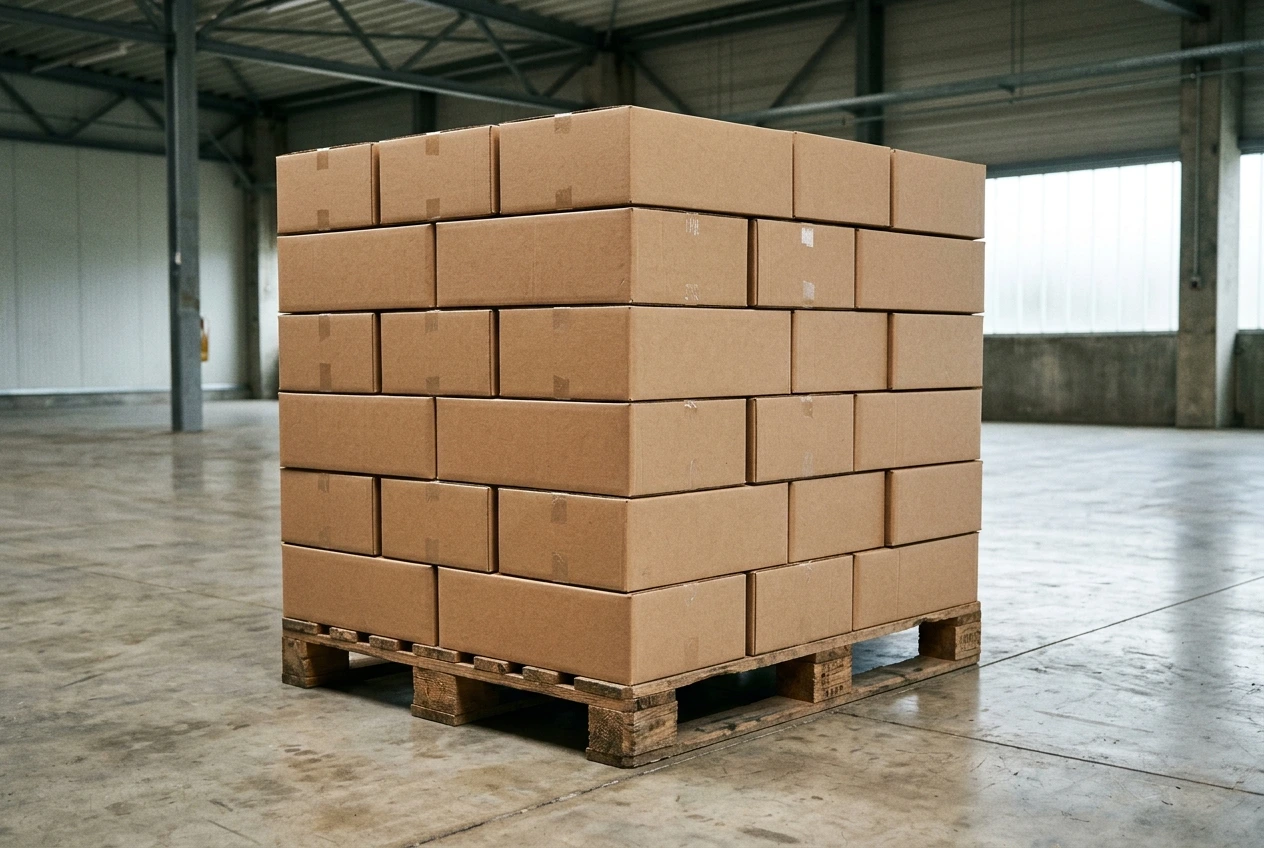
Read the AMT case in its original context
AMT’s own announcement is dated May 29, 2025. It describes a palletizing system built around FANUC’s CRX-30iA, with a custom interface for entering case dimensions and choosing a pattern, plus the ability to move between lines. Those are supplier statements, not results from an independent plant trial. Later trade coverage does not make the original announcement a new 2026 launch. See the AMT original release.
The public description is useful for identifying the proposed workflow. It leaves application questions to resolve: the production case, the tool, the farthest placement and the way a full pallet is exchanged. A selectable pattern on a screen is only one part of that review.
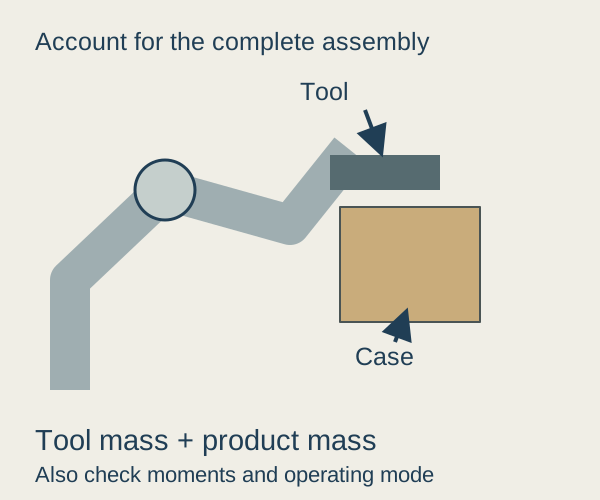
Separate robot payload from the lifted package
Ask for a load calculation for the complete moving assembly. The gripper and its attached equipment consume part of the allowable load; the product also has a center of gravity and creates moments. A robot payload label therefore does not give you the permitted mass of a shipping case.
The calculation should reference the exact robot, tool and operating mode. Keep the manufacturer’s configuration approval with the cell record. Public sources contain differing reach and load-mode descriptions, so this guide does not resolve them into a single numeric specification. A signed layout and current robot documentation are the evidence you need.
Accept the difficult placements and transitions
The far pallet corner and the top layer can reveal problems that a central, low placement will miss. Review the tool approach, case release and clearance for each. Include the lightest and heaviest relevant cases and any surface that affects grip. Avoid assuming that a single successful lift qualifies the full product range.
Use this record to keep responsibilities visible.
| Test condition | Question to resolve | Record to retain |
|---|---|---|
| Case arrives skewed or late | Who corrects orientation and authorizes a pick? | Infeed limits and recovery procedure |
| Grip is incomplete | How is a failed pickup detected and contained? | Tool-specific fault response |
| Top/far placement | Can the complete assembly reach and release cleanly? | Approved layout and representative demonstration |
| Pallet exchange | Where do incoming cases wait? | Buffer and full-pallet transfer sequence |
| Recipe changed | Who controls case and pallet data? | Recipe identifier, verification and access permissions |
| Cell moved | What must be re-established before restart? | Location, services and application review checklist |
Use this interface matrix during factory acceptance testing to document how the cell handles skewed arrivals, vacuum or mechanical grip loss, and pallet exchange buffering.
Treat collaborative operation as an application decision
The product, gripper, pallet edges and traffic around the cell all belong in the application review. A collaborative robot designation alone does not settle how people may approach the installed process. Have the responsible integrator document the hazards, protective measures and restart behavior for the complete installation. Verify perimeter guarding, area scanners, and speed-and-separation monitoring requirements through a formal cell risk assessment for the installed tooling and payload.
Mobility needs the same discipline. After relocating equipment, confirm the pallet datum, conveyor alignment, services and approved operating area. Budget time for those checks when evaluating the practical benefit of a movable cell.
Measure the whole production interval
Ask the supplier to demonstrate an interval that includes a pallet change, representative arrivals and an agreed recovery event. Count accepted cases at the output and record time spent waiting for cases, waiting for pallets and recovering from faults. Do not compare that interval with a video of uninterrupted robot motion as if both measures represented the same thing.
For economics, use your installed project cost and your own net annual savings. Net savings must account for retained operator duties, consumables and maintenance. A supplier’s payback statement has no transferable result without those assumptions.
Use the pallet calculation guide to prepare the load envelope and the robotic palletizing collection to keep the cell questions together.
Technical basis and scope
This integration analysis draws on Applied Manufacturing Technologies’ (AMT) May 29, 2025 CRX-30iA palletizing announcement and Hytrol’s zero-pressure accumulation documentation to structure cell boundary, end-of-arm payload, and pallet exchange acceptance checks. Reviewed October 2026.