On this page
- Start from the published magazine, not from a round count
- Calculate stack height and stack mass before accepting 15
- Match the grip side to the opening the conveyor presents
- Do not treat a presence photoeye as a broken-board inspection
- Compare the machines by the failure they actually produce
- Tie the release to the infeed conveyor
- Count the hidden cost of refills and air
- Scope and floor-magazine boundaries
- Technical basis and scope
An empty magazine causes downtime while cases are still arriving. Size the pallet dispenser machine by lifting mass and pallet height, then match its release to the infeed conveyor.
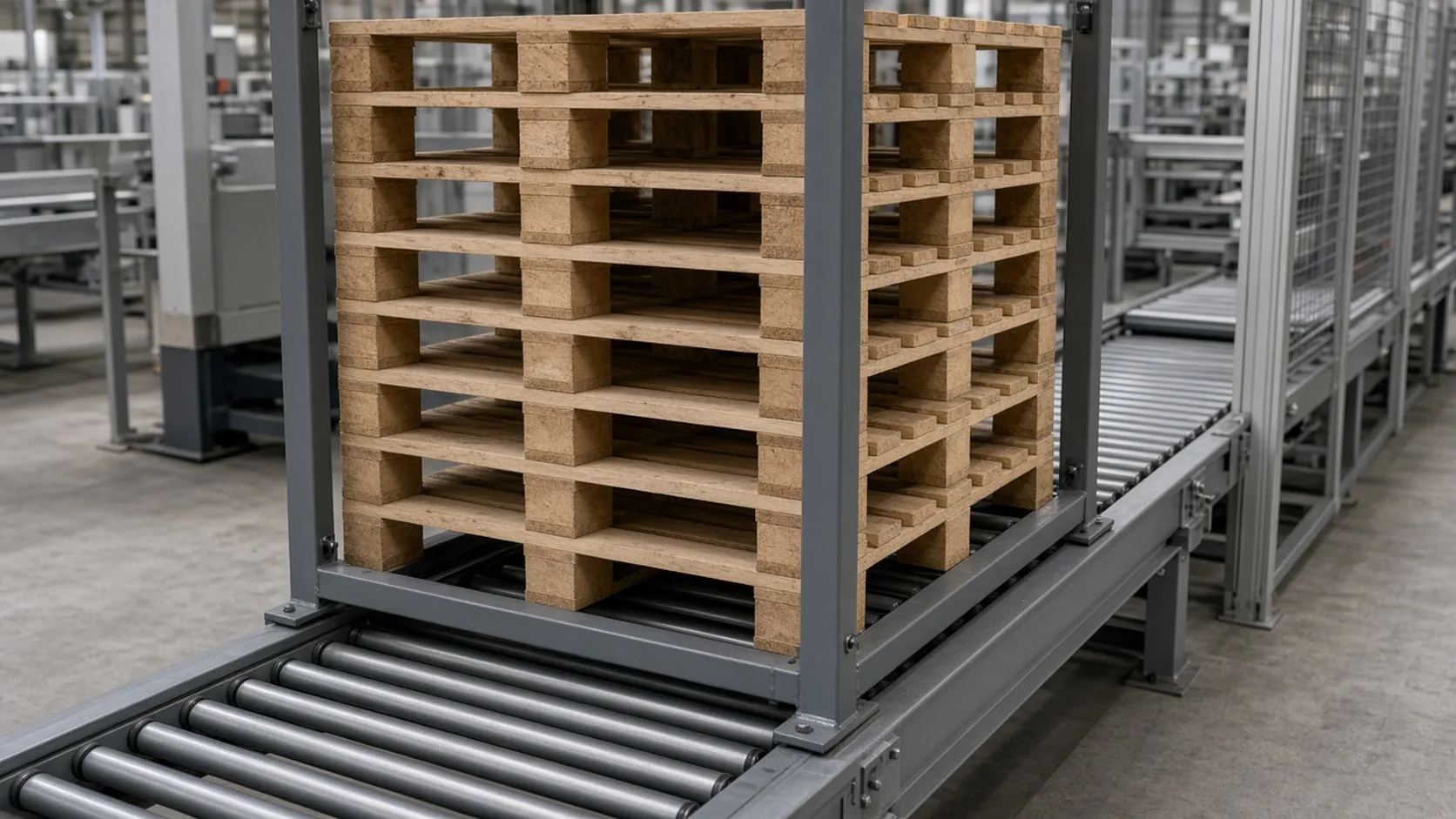
A pallet dispenser machine stores empty pallets and releases them one at a time. An automatic pallet dispenser built over a conveyor is not the same machine as a floor-level empty pallet magazine. The inline unit places a pallet on the conveyor under the frame. The floor unit hands a pallet to a truck at ground level. Use the published piece count only together with the published lifting mass, and compare the published cycle with the time between empty-pallet requests.
Start from the published magazine, not from a round count
A 15-pallet label is a rating for a stated pallet size and a stated mass. It is not a universal stack.
| Input or item | Published baseline | Why it matters |
|---|---|---|
| PALOMAT Inline pneumatic, article 125001 | 15 pallets, 500 kg, pallet 1,200 × 800 × 144 mm, machine 1,350 × 1,481 × 2,144 mm, 6 bar + 24 V DC, 55 litres per cycle | Sets count, mass, envelope and air for one inline model |
| Same family, brochure cycle | Pneumatic 10–15 s per pallet at 6–7 bar; electric 12–15 s; both listed as 15 pallets / 500 kg | The slower published figure is the one a line must clear |
| PALOMAT Inline Electric sensor list | Two SEW lift motors, 0.25 kW and 1.1 A each (0.5 kW and 2.2 A together) at 380 V AC; two LINAK LA28 grippers; two SICK VTE18 photoeyes; six SICK IME18 inductive sensors | Presence devices are listed separately from the lift |
| EPAL Euro pallet | 800 × 1,200 × 144 mm, about 25 kg, 4-way entry; drawing shows 144 mm +7 / −0 mm | Turns a piece count into height and mass |
| PALOMAT Greenline | Floor level, 15 pallets / 500 kg or 25 / 700 kg, 110–240 V AC; 550 W while lifting 500 kg | A floor destacker does not discharge onto the cell conveyor |
| Q-System Q1 | EURO 1,200 × 800 mm; 15 pallets / 500 kg or 25 / 835 kg; photocells start the cycle and act as a safety device | Another floor magazine with its own mass cap |
PALOMAT lists the Euro pallet for article 125001 as 1,200 × 800 × 144 mm. EPAL lists the same pool pallet as length 800 mm and width 1,200 mm. The footprint is the same board; the axis names are not. Use the grip-side note, not the word “length,” to decide which face the grippers must see.
The pneumatic datasheet states 6 bar. The September 2025 brochure states 6–7 bar for the pneumatic inline family. Keep both figures on the record and use the pressure the selected unit’s sheet actually requires. The brochure lists the lift supply as 2 × 380 V AC, 1.2 A, while the electric product page lists 1.1 A and 0.25 kW per motor. Quote the page that belongs to the unit being ordered. PALOMAT supplies the inline magazine as a sub-assembly with a declaration of incorporation. The integrator owns installation of the finished line.
Calculate stack height and stack mass before accepting 15
Two separate limits apply. Height uses the pallet’s own thickness. Mass uses the empty pallet weight against the lifting capacity.
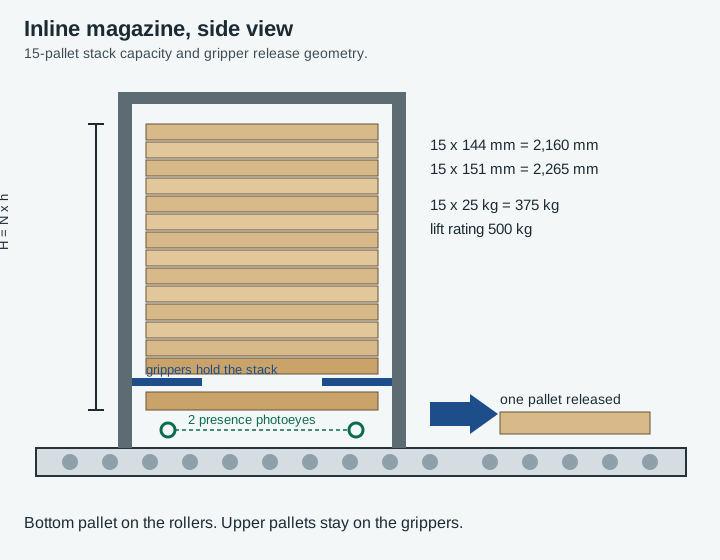
Stack height H = N × h
Stack mass M = N × m
For article 125001 the published count is N = 15 and the stated pallet height is h = 144 mm. Nominal height is 15 × 144 mm = 2,160 mm. The EPAL drawing allows 144 mm +7 mm, so h can be 151 mm. Then 15 × 151 mm = 2,265 mm. The stack at the upper tolerance is 105 mm taller than the nominal stack. That 105 mm is most of an extra pallet. A magazine can run out of physical height before it runs out of piece count when every pallet sits at the plus tolerance.
The published machine height for article 125001 is 2,144 mm. That number is the machine envelope on the datasheet. It is not 15 × 144 mm, and it is not a measured clearance above the stack. Do not subtract 2,144 from 2,160 and call the remainder a gap.
EPAL lists the empty Euro pallet at about 25 kg. At that figure, 15 × 25 kg = 375 kg, and 500 − 375 = 125 kg remains under the published lifting capacity. The 25 kg figure is approximate. Weigh a sample from the pool that will actually be loaded. If that mean mass is 34 kg, then 15 × 34 kg = 510 kg, which is over 500 kg. The largest integer count that stays under the rating is floor(500 / 34) = 14, because 14 × 34 kg = 476 kg.
Rules of thumb
If measured mean empty-pallet mass times the proposed count is at or above the published lifting capacity for that pallet size, cut the count to the largest whole number that stays under the capacity. The piece rating stops being usable at the mass limit.
If the palletizer requests the next empty pallet in less than the published cycle upper bound of 15 seconds, one inline release cannot be assumed to finish inside that request. The brochure lists 10–15 seconds pneumatic and 12–15 seconds electric.
If the pallet is not a 4-way pallet, the inline magazine’s published handling statement does not cover it. The datasheet limits the family to 4-way pallets and then assigns a grip side.
Match the grip side to the opening the conveyor presents
Article 125001 grips the long side, 1,200 mm, of a 1,200 × 800 × 144 mm pallet. Article 125401 grips the short side, 800 mm, of an 800 × 1,200 × 144 mm pallet. The same rule appears on the 1,219 × 1,016 mm rows: the starred models grip 1,200 or 1,219 mm, and the double-starred models grip 800 or 1,000 mm. Turning the pallet 90 degrees on the conveyor selects a different article number.
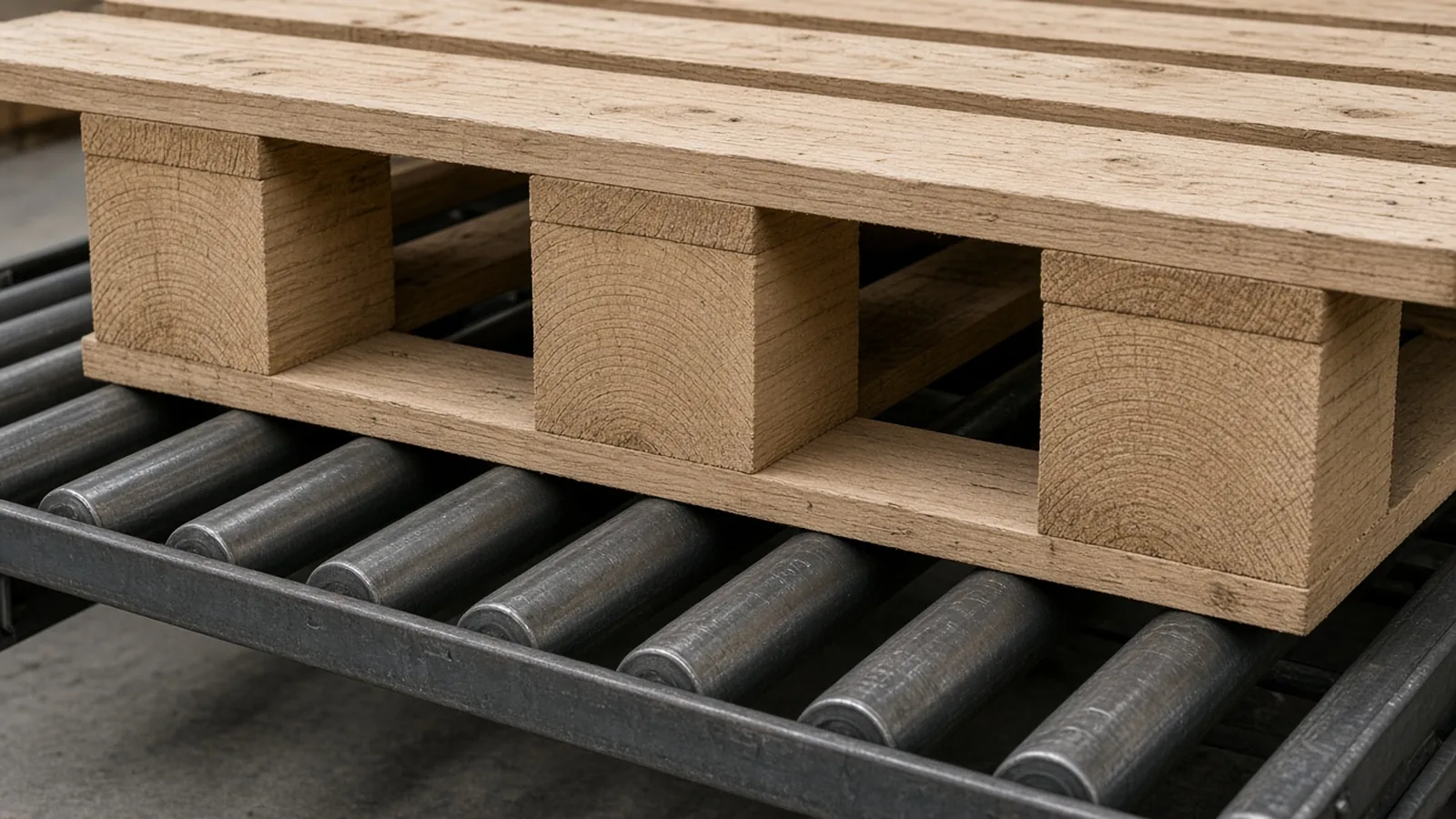
EPAL Euro pallets have entries on all four sides. A two-way pallet does not. A gripper aimed at a closed board will not find the opening the model was built around. That is a mechanical mismatch, not a tuning setting.
Do not treat a presence photoeye as a broken-board inspection
The inline brochure includes two photo sensors wired to a terminal strip. The electric specification names them: two SICK VTE18-3F4712 photoelectric sensors, two inputs, plus six inductive proximity sensors on the mechanism. Greenline and the Q-System Q1 also use photo sensors to see that a pallet is there and to start a stack or destack cycle. Q-System describes those photocells as a safety feature and as the trigger. A full-stack sensor is listed as an option on the Q1, not as a bottom-board gauge.
A beam that makes or breaks on a block proves presence at that height. A missing or shifted bottom board can still leave enough material in the beam, or can fail the beam for a reason the program reads as “no pallet.” Neither result is a deck inspection. The prevention is a separate bottom-support check before the pallet enters the magazine. Keep the two published photoeyes in the presence circuit the manufacturer listed.
Compare the machines by the failure they actually produce
| Arrangement | Where the empty pallet leaves | Dominant failure mode and prevention |
|---|---|---|
| PALOMAT Inline pneumatic over a conveyor | One pallet onto the conveyor under the frame, 10–15 s, 55 litres at the stated air supply | Gripper faces a closed side or a pallet rotated 90 degrees from the article’s grip note. Prevention: lock the conveyor orientation to the starred grip side before the frame is built. |
| PALOMAT Inline Electric | Same inline discharge, 12–15 s, two 0.25 kW lift motors | The two VTE18 photoeyes are used as a broken-board reject. Prevention: leave them as presence inputs and inspect bottom boards upstream of the stack. |
| PALOMAT Greenline | Floor level, one pallet at a time, to a pallet truck or forklift | The floor unit is treated as the palletizer infeed. Prevention: add an explicit transfer onto the cell conveyor; the Greenline specification does not describe a conveyor discharge. |
| Q-System Q1 | Floor level, forklift or pallet jack, one pallet at a time | A 25-pallet stack is loaded because the cover allows 25, while the pallets exceed 835 kg. Prevention: apply M = N × m to the kilogram limit printed for that cover. |
Tie the release to the infeed conveyor
The inline magazine is placed above the conveyor and is delivered with a terminal box for the line controller. The electric bill of signals is concrete: four outputs and four inputs for the two gripper actuators, six inputs for the inductive sensors, and two inputs for the photoeyes. Those points tell the cell that a grip moved and that a pallet is in view. They do not, by themselves, tell the conveyor that the downstream position is clear.
Agree three states with the conveyor that receives the pallet. The magazine may release only when the receiving zone is empty. The conveyor may move that pallet only after the grippers have let go. A second release waits until the first pallet has left the zone. The same boundary record used for case accumulation applies here, with the load changed from a case to an empty pallet. Use the palletizing conveyor handoff for the hold, release and recovery states, compare case-level 24V MDR photoeye zones against heavy-duty pallet accumulation in the zero pressure accumulation conveyor guide, and keep this magazine on the empty-pallet side of that boundary.
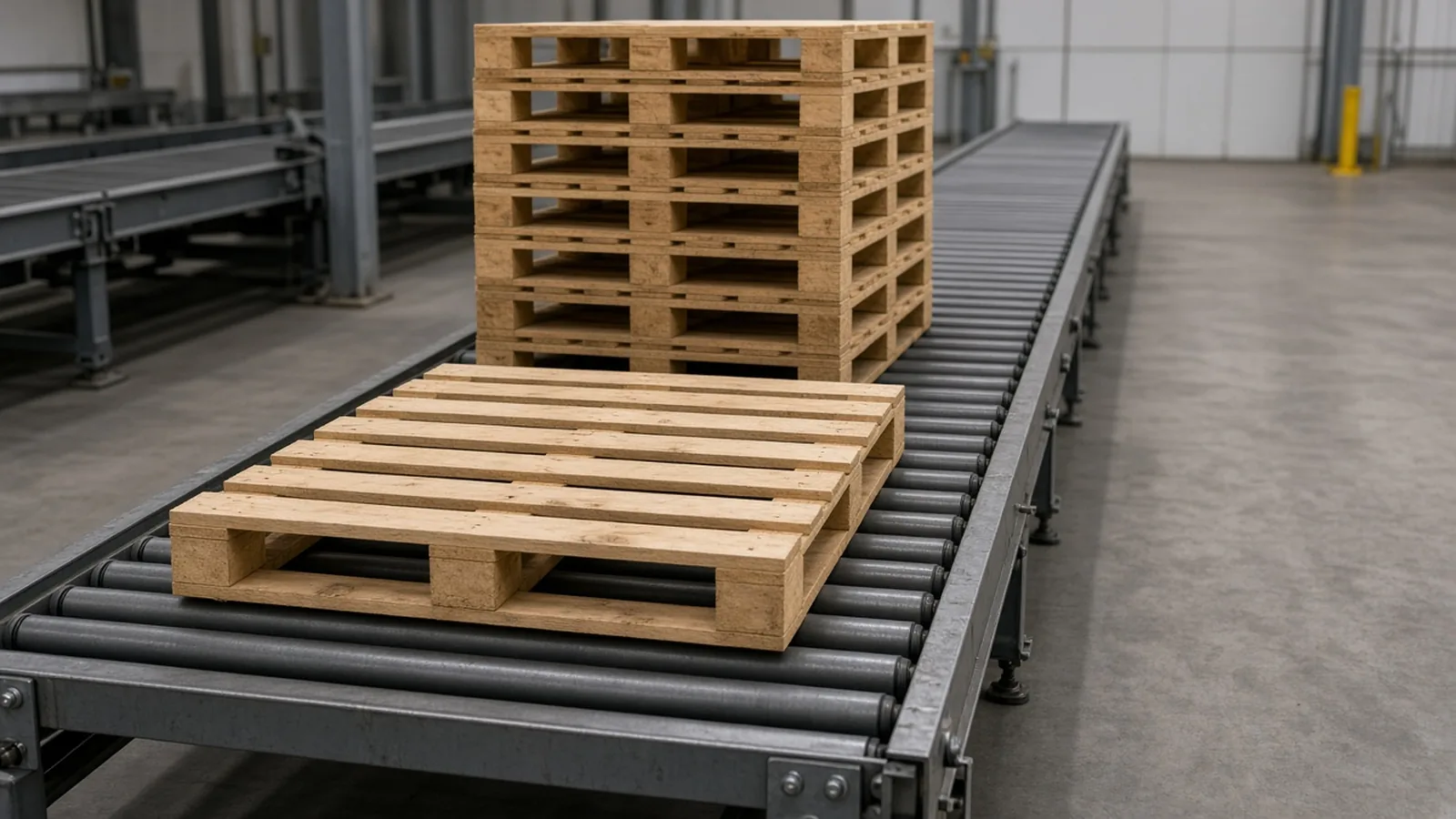
Worked interval. If the cell finishes one loaded pallet every 40 seconds, it needs one empty pallet on that interval. A 15-second release fits inside 40 seconds. It does not fit inside a 12-second request. Time to empty a full 15-pallet magazine at a 40-second interval is 15 × 40 s = 600 s, which is 10 minutes.
Count the hidden cost of refills and air
Reloads per hour = empty pallets per hour / N
At a planning rate of 90 empty pallets per hour and N = 15, the magazine needs 90 / 15 = 6 reloads each hour. Each reload is a forklift or truck intervention at the magazine. If that intervention takes longer than the conveyor can run on pallets already released, the cell starves even though the cycle time looked acceptable. Six reloads an hour is the operating cost that a 15-pallet count creates at that rate. A 25-pallet floor magazine, such as the Q1’s 25-pallet / 835 kg rating, changes the reload count only when the mass limit still allows 25.
Air per hour = empty pallets per hour × litres per cycle
For the inline pneumatic rating of 55 litres per cycle, 90 × 55 L = 4,950 L per hour. That is the published per-cycle volume added up. It is not a compressor free-air specification, and it is not the Greenline’s 550 W electric lift. The electric inline nameplate of 0.5 kW for the two lift motors is likewise not an energy-per-pallet figure. The sheets do not state how many seconds the motors run inside the 12–15 second cycle.
The expensive miss is a stack that exceeds 500 kg or a broken bottom board that the presence photoeyes accept. Either one stops the palletizer, not just the dispenser. The layer pattern in the palletization calculations starts only after an accepted empty pallet is on the datum. Return to the robotic palletizing collection for the cell that consumes that pallet.
Scope and floor-magazine boundaries
For cells where a forklift places each pallet directly or where loads build on slip sheets without a pallet magazine, apply the cell’s direct infeed interlocks instead. Floor-level magazines that build stacks solely for pallet trucks or forklifts follow their own piece-count and mass ratings (such as Greenline or Q-System Q1) rather than inline conveyor cycle and air-consumption parameters.
Where palletizing lines dispense bottom liners, tie sheets, or tabbed slip sheets, compare vacuum pickup, roller pitch, and push-pull transfer in our slip sheet dispenser versus pallet infeed guide.
Technical basis and scope
This reference draws on the PALOMAT Inline pneumatic datasheet (article 125001), the PALOMAT Inline brochure (September 2025), PALOMAT Inline Electric and Greenline specifications, EPAL Euro pallet product sheet and drawing PB 05/2016, and Q-System Q1/Q5/Q Double pallet-magazine data sheets.