On this page
A palletization calculation should produce a candidate arrangement and a list of constraints still to check. Begin with the usable footprint, case dimensions and available load height, then check mass, support and robot access before treating the result as a production pattern.
Use shipping dimensions and a common unit
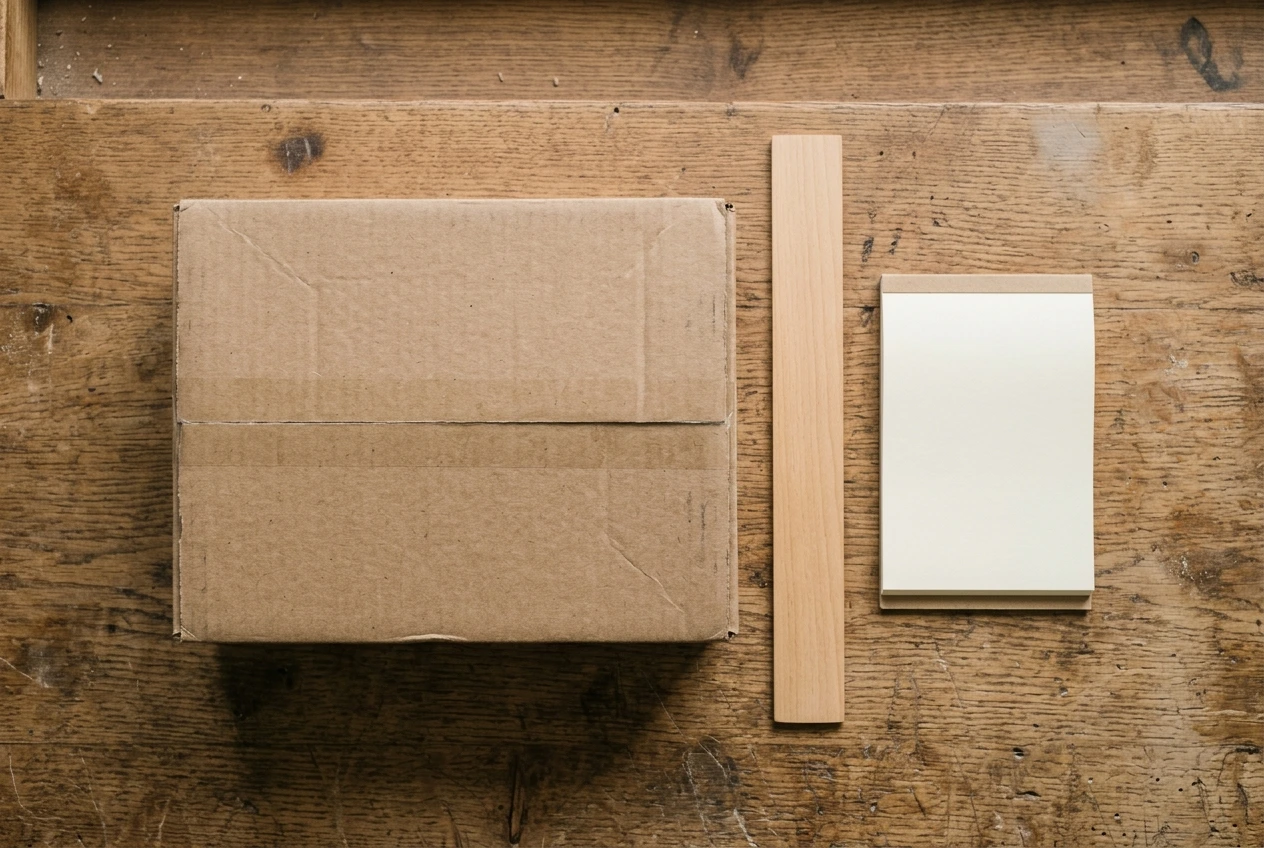
Record external case length, width and height after filling and closing. Internal box dimensions describe another purpose. Include bulging, closure features and the normal variation that affects fit. State whether the pattern allows a case to rotate in the horizontal plane and whether another orientation is prohibited by its contents.
The usable pallet area can be smaller than the nominal deck. Agree edge clearance and overhang policy before calculation. Keep the pallet’s own height and mass separate from the stacked cases. The limit may come from a customer, handling equipment or a transport envelope; use the controlling value with its source.
Start with two uniform rectangular grids
For pallet footprint L × W and case footprint a × b, compare:
- Orientation A: floor(L ÷ a) × floor(W ÷ b).
- Orientation B: floor(L ÷ b) × floor(W ÷ a).
Each result is a uniform grid with no overhang and no clearance allowance. A mixed-orientation pattern may fit differently. These calculations do not search every packing arrangement or evaluate stability.
Work through a transparent example
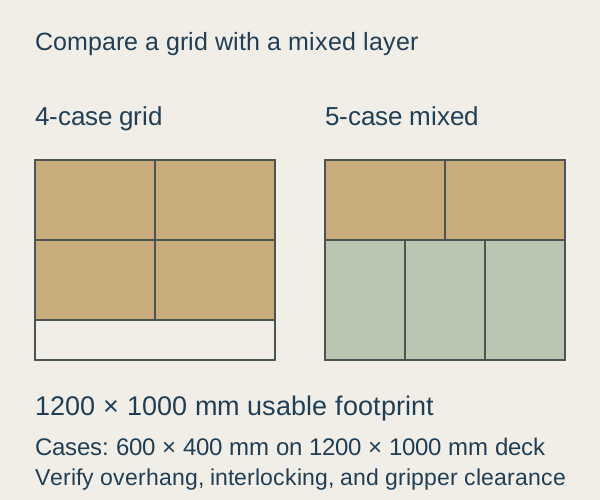
Consider a standard 1200 × 1000 mm usable pallet footprint loaded with 600 × 400 × 250 mm shipping cases on a 150 mm-high pallet base under a 1400 mm maximum overall height limit.
The uniform grid gives floor(1200/600) × floor(1000/400) = 2 × 2 = 4 cases. Rotating the uniform grid gives floor(1200/400) × floor(1000/600) = 3 × 1 = 3. A mixed arrangement can fit five in this example: two 600 × 400 cases in one row, and three rotated 400 × 600 cases in the remaining row. That shows why choosing the larger of two uniform-grid results is not full pattern optimization.
The height limit permits floor((1400 − 150)/250) = 5 layers before adding any tier-sheet thickness or clearance. A four-case grid would contain 20 cases. If each case weighs 10 kg and the pallet 25 kg, gross mass is 225 kg. After screening layer count and gross mass, evaluate corner-to-corner column support, interlocking tie layers, and tier-sheet thickness for the stacked unit load.
Add the constraints that geometry leaves out
| Input or constraint | How to establish it | Why a fit result can still fail |
|---|---|---|
| Usable footprint | Agreed pallet drawing and overhang/clearance policy | Nominal dimensions can hide forbidden edge space |
| Load height | Customer and handling limits, including pallet and sheets | Case layers can exceed the overall envelope |
| Gross mass | Actual filled-case and pallet mass | Pallet, conveyor or downstream equipment may govern |
| Stack support | Package evaluation for the selected pattern and conditions | An efficient layer can leave weak or unsupported areas |
| Tool access | Approved gripper and robot layout | A case can fit on the pallet but be inaccessible for placement |
| Transport restraint | Load-specific qualification plan | Geometric fit does not establish distribution stability |
Signode’s unitizing overview describes protective elements such as tier sheets and edge protection. If these are included, add their geometry and handling to the calculation rather than appending them after the robot recipe is set.
Keep the output auditable
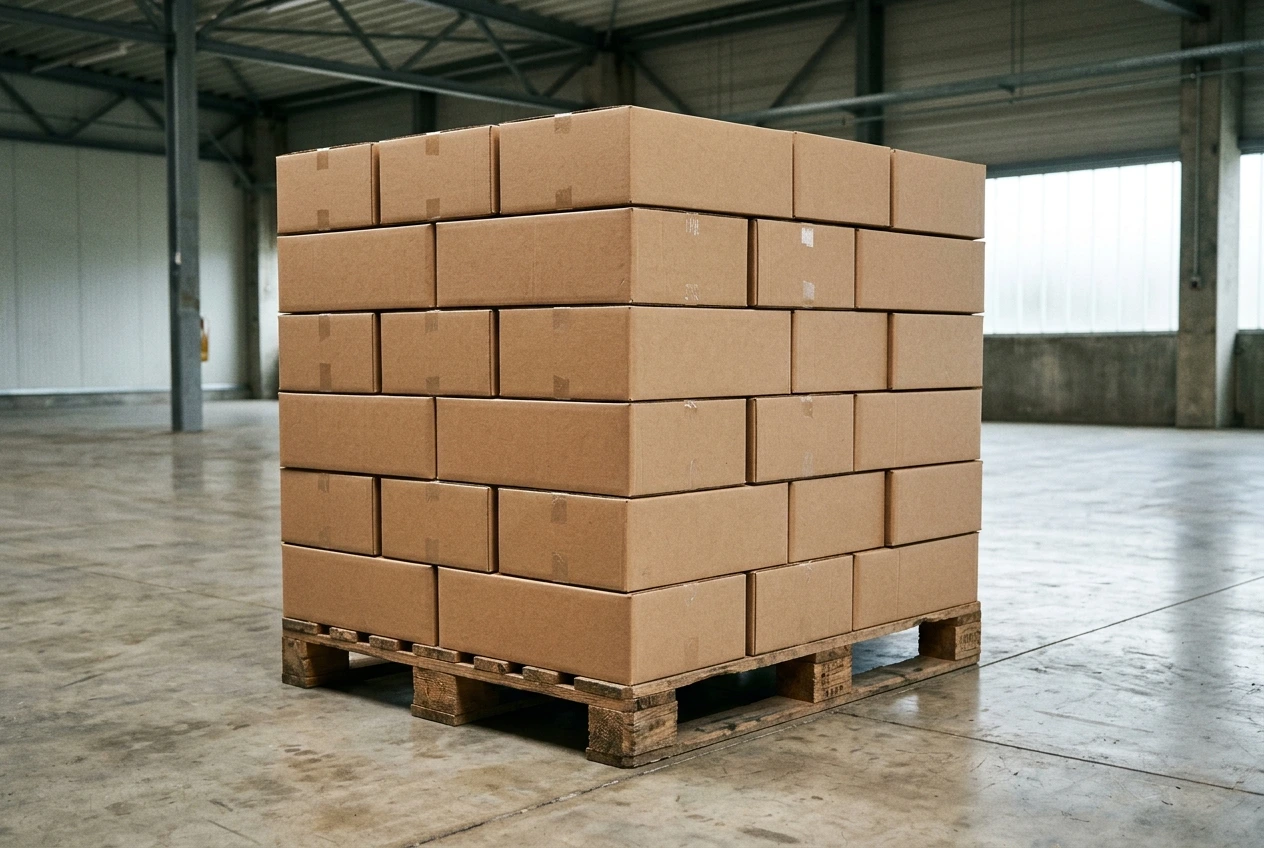
Save the dimensions, units, orientation rule, chosen pattern and revision date with the recipe. Retain the rejected alternatives and the reason for choosing the final one. A later carton change should trigger a review of the load record rather than an unexplained edit to the robot program.
The calculator below screens the two uniform grids and height and mass limits. Pair geometric screening with stack-compression evaluation, gripper reach verification, and transport restraint testing. For the cell review after planning the load, use the cobot integration checklist and the robotic palletizing collection.
Technical basis and scope
This load-screening model combines integer rectangular footprint geometry, vertical stack height limits, and gross mass summation with Signode’s unitizing system guidance on tier sheets, edge protection, and unit-load containment. Reviewed October 2026.
Uniform-grid pallet calculator
Enter usable pallet dimensions, external case dimensions, height limits (mm), and mass limits (kg) to screen uniform rectangular layer orientations A and B against gross height and payload constraints.