On this page
Size a case erector magazine from its usable storage length and the measured pitch of complete folded blanks, then calculate the refill window at the line’s case demand. Qualify blank feed and squareness through bottom sealing and delivery to the packer: reliable pickup is only one part of that handoff.
For a new case erector machine or a magazine extension, the selection starts with four inputs:
| Input | Where to obtain it | Selection consequence |
|---|---|---|
| Active magazine length and usable blank count | Machine drawing and a loaded production stack | Establishes storage available for feeding |
| Folded blank pitch and case geometry | Counted stack, corrugated drawing and production samples | Converts storage length into a case count |
| Case demand and desired refill interval | Line production plan, in cases/min and minutes | Sets consumption before replenishment |
| Refill reserve and packer receiving conditions | Replenishment procedure and interface specification | Sets response time and acceptable case presentation |

The images in this guide are AI-generated editorial illustrations of generic equipment and materials.
Size the magazine for the required refill interval
Use the active blank-storage length and reserve enough cases for replenishment after the low-magazine signal. Overall magazine length includes space that may be unavailable to the stack.
Pearson’s CE25-G LH drawing 638032R-3, revised May 23, 2025, makes that distinction explicit. Its representative configurations are:
| CE25-G configuration | Nominal magazine length | Active blank-storage length |
|---|---|---|
| Standard | 4 ft | 3 ft |
| Optional extension | 6 ft | 5 ft |
| Optional extension | 8 ft | 7 ft |
The drawing marks its dimensions as preliminary; use the final order drawing to establish installation space and usable storage for the selected configuration.
Measure a counted stack of complete folded knockdown cases in the intended loading condition. Divide stack depth by blank count to obtain effective pitch, p_eff. Measure along the same axis as active storage length, L_active. Folded panels, joints and the way the stack sits in the magazine all contribute to that pitch. A B, C or BC flute designation describes board construction; the capacity calculation needs the complete folded case.
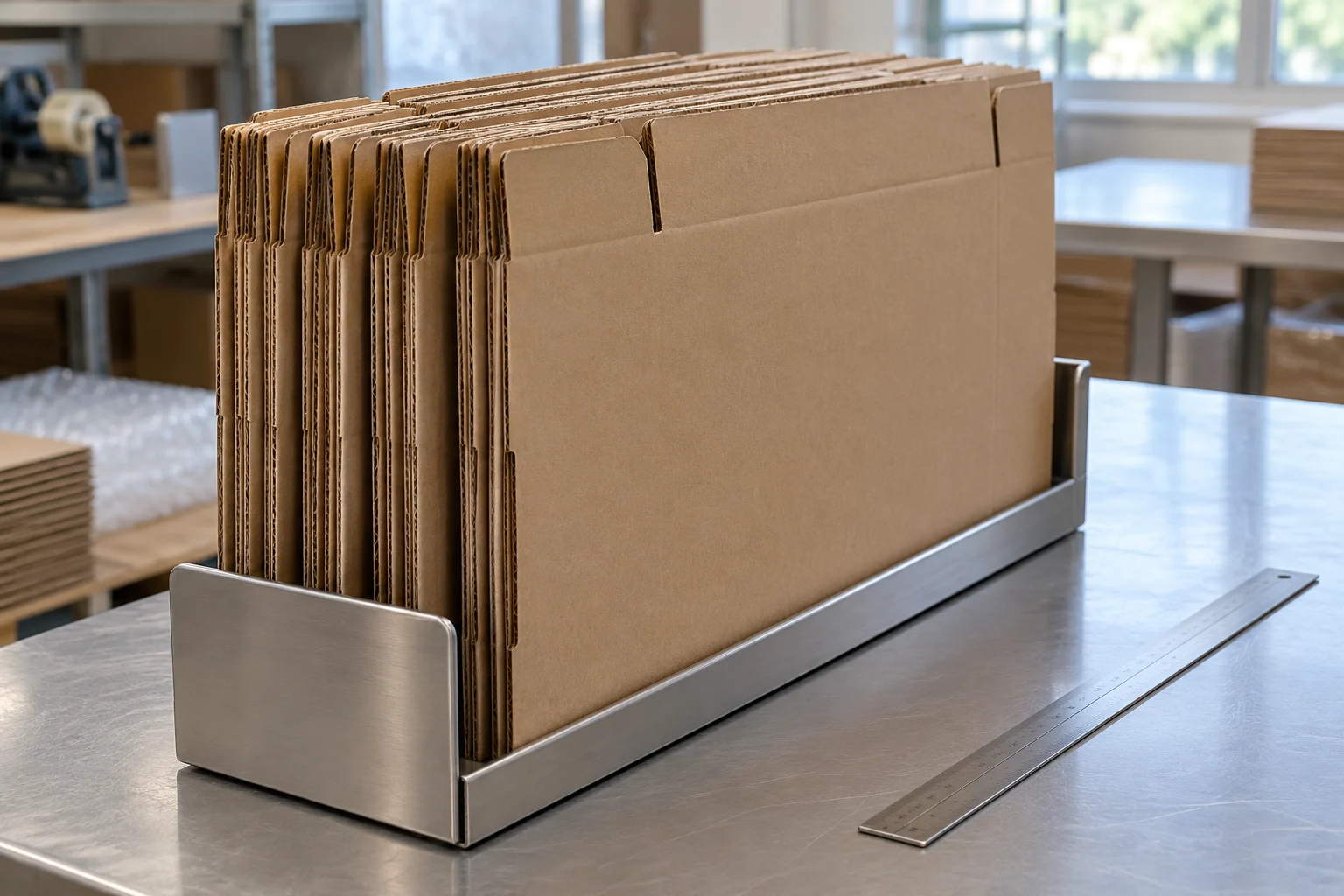
For a consistent stack arrangement, the capacity estimate is:
N_capacity = floor(L_active / p_eff)
Use the same length units in numerator and denominator; floor rounds down to a whole blank. Check the result against the usable loaded count and reliable feeding at both full and low magazine levels. Angled stacks, followers and retainers can change how much of the nominal space is usable.
For steady consumption at r cases/min, with one blank used per case:
| Quantity | Calculation | Meaning |
|---|---|---|
| Full-to-empty time | T_empty = N_loaded / r | Minutes until the loaded supply is exhausted |
| Time to refill signal | T_trigger = (N_loaded − N_trigger) / r | Minutes before replenishment is requested |
| Response window at the signal | T_response = N_trigger / r | Minutes remaining for replenishment |
| Count needed for a target interval | N_required = ceil(r × T_target) + N_trigger | Blanks needed to reach the target time before the signal |
| Corresponding active length | L_required ≈ N_required × p_eff | Initial storage-length estimate |
Here N_trigger is the remaining count at the refill signal, and ceil rounds up to a whole blank. Select that reserve from the actual replenishment response and the machine’s loading procedure.
Published-specification example: Lantech’s C300 specifications list approximately 200 cases in the magazine and a throughput of 10 cases/min. At continuous rated consumption, T_empty ≈ 200 / 10 = 20 minutes. The scheduled refill signal occurs earlier, according to the selected reserve and usable count for the case SKU.
Selection rule: if replenishment takes longer than N_trigger / r, increase the available response window or change the replenishment arrangement. A longer magazine extends time to the signal; keeping the same low-stock trigger leaves the response window unchanged. For variable production, total the blanks consumed over the intended unattended period instead of applying the machine’s maximum rate throughout.
Separate one blank and verify the vacuum pickup
Treat singulation, gripping and opening as separate events. A separator controls which blank leaves the stack, cups grip the intended panel, and the opening mechanism establishes the case shape. Record where a failure first appears before changing settings.
Lantech’s Take Control of Case Erecting describes separation retainers coordinated with pickup and a vacuum frame gripping two panels. Pearson’s Multi-Magazine Robotic Case Erector uses an articulated pick-off motion, opposing vacuum for opening and a squaring arm. These architectures give the trial distinct checkpoints: one blank leaves, the grip holds, and the case opens fully.
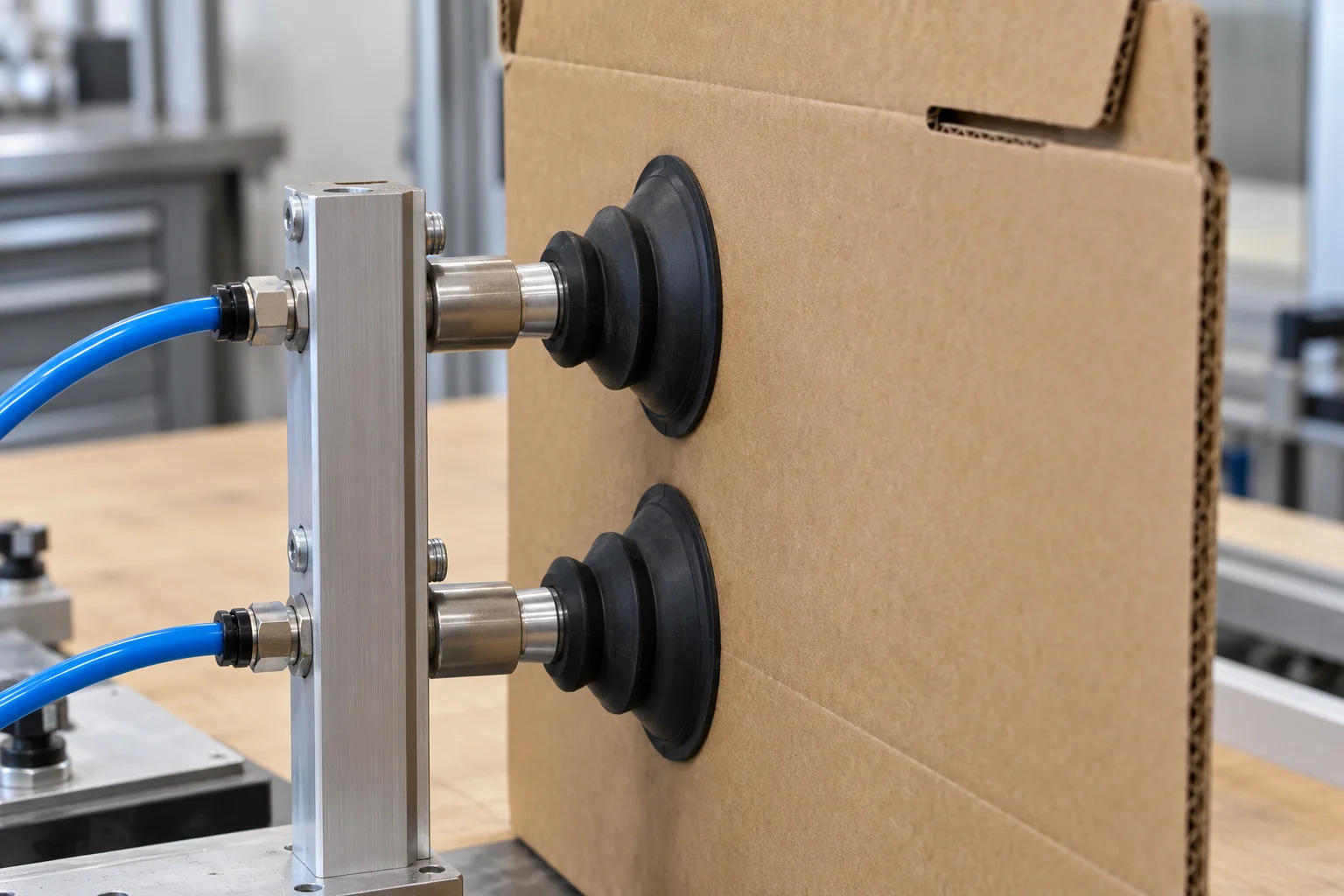
Piab’s Automation by vacuum technology explains that porous cardboard admits air into the vacuum system. Selection therefore needs enough flow to handle leakage, compatible cups and sufficient time to establish the required vacuum during pickup. Check the vacuum signal at the event against the machine’s specified threshold and timing.
Schmalz’s Design of the Suction Cup gives the static relationship F = Δp × A, where Δp is the difference between ambient and system pressure and A is effective suction area. That relationship explains the value of a good seal; accelerating and opening a blank also introduce dynamic loads. Schmalz recommends trials on porous workpieces, so use the production corrugated material when qualifying the grip.
| Observed event | What to inspect or record | Next trial check |
|---|---|---|
| No blank leaves the magazine | Presentation, cup contact and vacuum build-up at pickup | Compare the event with the machine’s setup and vacuum requirements |
| A second blank follows the first | Separator/retainer position, stack condition and pick-off motion | Observe whether exactly one blank clears at full and low stack levels |
| A picked blank drops | Cup contact, vacuum signal through travel and release timing | Locate when the grip is lost in the cycle |
| One blank leaves but opens incompletely | Opposing grip, fold/score behavior and squaring sequence | Trial the affected blank lot with the specified forming setup |
Keep the lot identifier and machine recipe with each observation. Include production lots with the poorest observed flatness, and change settings through the OEM’s setup procedure. Perform adjustments and fault clearing under the machine’s guarded maintenance procedure.
Hold the case square through the packer handoff
Retain control through bottom folding, sealing and discharge, then inspect the case where the packer receives it. A correctly opened case can change shape during a later transfer.
In Pearson’s multi-magazine example, a squaring arm supports forming and synchronous lugs maintain alignment through bottom folding and sealing. Lantech’s Why Do Case Erectors Jam? likewise treats forming, flap folding and sealing as successive control points. The useful acceptance question is where the case first departs from the receiving geometry.

A practical geometry record compares corner-to-corner diagonals at a consistent cross-section:
Δd = |d1 − d2|
Identify the same four corner points for each reading and record the restraint condition. Inspect adjacent corners and wall straightness alongside the diagonal difference: a distorted four-sided opening can have equal diagonals. Soft walls and moving flaps also make inconsistent reference points misleading.
| Checkpoint | Record | What the comparison helps locate |
|---|---|---|
| After forming | Opening diagonals, corners and wall shape | Variation introduced during opening and squaring |
| After bottom sealing | Same geometry checks plus flap alignment and closure | Shape changes during folding, sealing or transfer |
| At packer entry | Opening geometry, orientation, presentation height and stability | A receiving-interface mismatch or loss of control after discharge |
Set acceptance limits with the erector and packer suppliers using actual case dimensions and product-loading clearance. Keep bottom closure and entry orientation in the same acceptance record so a case passes as a usable package at the receiving station.
Define who owns each transfer and what happens when the receiving machine stops using the packaging-line integration guide. Where bottles or other products approach the packer on a separate stream, the RoboSELEX interface analysis helps translate grouping flow into case demand. The supply of empty cases and the grouped product must meet at that shared loading point.
After case packing, the random versus uniform case sealer infeed spacing guide details how box separation, upper mast travel, side-belt synchronization, and tape head handoff govern top closure.
Run the selection trial at the actual line boundary
Trial the intended blank lots, replenishment method and packer interface at the planned operating rate. Lantech’s jam guide recommends testing customers’ cases; the Pearson CE25-G drawing also identifies scoring style and quality as inputs to machine performance.
Include representative small and large formats from the intended case range. Agree the trial duration, quantities and acceptance limits before the demonstration, then keep one record per SKU and blank lot:
- Magazine: measured folded pitch, active length, loaded count, refill trigger, elapsed replenishment time, and feed observations at full and low levels.
- Pick and form: missed picks, extra blanks following, dropped blanks, incomplete openings, vacuum signal timing and the active machine recipe.
- Delivery: geometry at each checkpoint, bottom closure, packer presentation and accepted cases at the planned rate.
- Stop and restart: downstream-blocked response, retained case condition and the first cases accepted after restart.
Replenishment while running is a feature of the complete safeguarded arrangement. Pearson’s multi-magazine project permits filling a low magazine while the robot picks from another through its magazine layout and safety programming. Follow the selected machine’s replenishment procedure when timing the refill task.
Compare each case erecting machine configuration using usable refill time and accepted cases at the packer. Also record labor time spent replenishing, discarded blanks, fault recovery and format changes; these observations reveal operating-cost differences that a magazine-length label misses.
For the supplier review, bring the corrugated blank drawing, unfolded and folded dimensions, case style, flute and board construction, production samples, required cases/min, desired minutes between refills, bottom-seal method and downstream packer receiving specification. Those inputs connect the magazine choice to the case the line must actually accept.