On this page
RoboSELEX should be evaluated as the bottle-grouping interface ahead of a case packer. Define the acceptable bottle flow and the packer’s receiving condition before treating the published machine description as a line design.
Establish where grouping ends
Sidel describes Cermex RoboSELEX as a continuous-motion collating infeed system using two delta robots. Its product page places spacing and pitching in the upstream conveyors and grouping before the case packer. The robots do not, by themselves, establish the availability of cases, the loading operation or the subsequent case closure. Sidel’s product description is the source for that boundary.
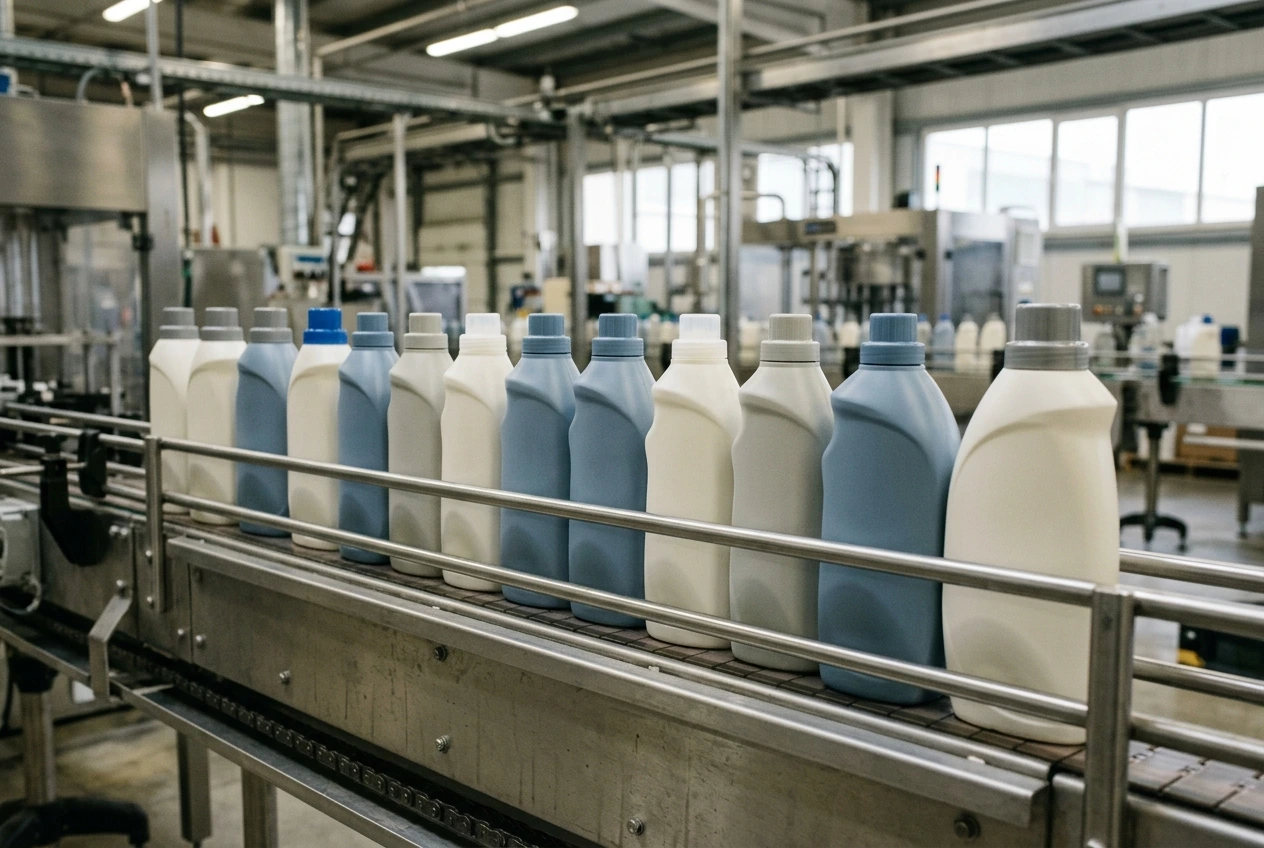
Draw the line around the grouping function first. On the left, identify the bottle condition released by the last conveyor. On the right, define the arrangement and orientation the packing operation can accept. Put inspection, rejected bottles and damaged packs on the drawing as separate destinations rather than assuming that everything continues downstream.
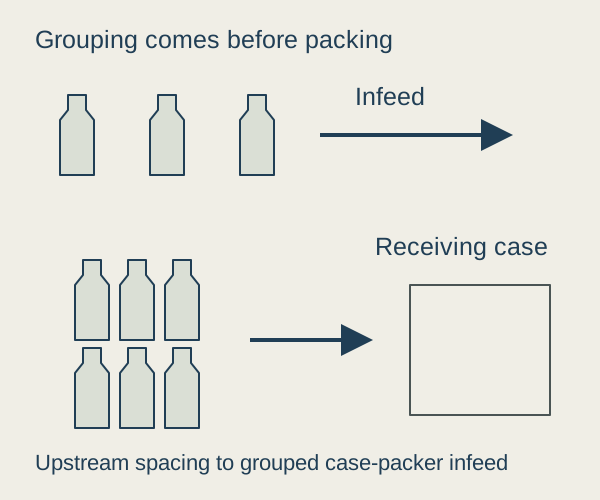
Keep accumulation outside the promise
An accumulation-free grouping process does not give the whole line unlimited waiting capacity. A downstream stop still leaves a physical question: where will arriving bottles go, or which upstream machine must stop releasing them? The correct response depends on the bottle and the installed line.
Ask the equipment owners to agree on the last acceptable release, any controlled runout and the restart condition. For a shaped bottle that cannot tolerate product-to-product pressure, simply adding a contact buffer may defeat the handling objective. Check the bottle in its filled state, including its base, cap and labels. The ability to convey an empty reference bottle does not establish that the production package will remain stable.
Write the interface record before the demonstration
Use the table as an agenda for the line review. Use this boundary table during line integration reviews to align upstream conveyor pitch control with downstream case-packer transfer requirements.
| Boundary | Record before testing | Evidence to request |
|---|---|---|
| Upstream conveyor | Filled bottle samples; orientation; spacing at release | Demonstration with irregular arrivals and an upstream pause |
| Grouping to packer | Collation recipe and receiving position | Complete transfer into the actual packing arrangement |
| Downstream unavailable | Stop owner and permitted runout | A controlled stop with no unassigned product |
| Recipe change | Bottle, collation and tooling identifiers | First accepted group after the agreed change procedure |
| Fault recovery | Location of interrupted groups and rejected units | Documented recovery that preserves product count |
Sidel presents puck removal as a possibility for shaped bottles that are conveyable but unsuitable for accumulation. Treat that as a sample-specific proposal. Do not remove carrier requirements from the project brief until the actual bottle has been evaluated across the relevant transfers.
Translate bottle flow into case demand
A bottle rate alone cannot tell you the case packer’s required output. Divide the incoming bottle rate by bottles per complete case to obtain an idealized case demand, then consider incomplete groups, interruptions and the packer’s actual operating sequence. The division describes material balance; it does not predict sustained line output.
A larger collation changes more than the case count. The receiving geometry, bottle orientation and handling at the packing boundary must still match. Require a record for each production format you expect to accept, rather than extrapolating from the smallest demonstrated pack.
Distinguish a product announcement from a line result
The original Sidel Interpack announcement and later trade coverage describe a supplier’s concept and intended applications. They do not establish your line’s output, availability or changeover performance. Keep the application review focused on the actual bottle set, the receiving packer and the stopping sequence. Public statements about broad compatibility do not replace a layout and interface agreement.
For the waiting and release record after case packing, use the palletizing conveyor guide. The wider packaging line integration collection connects this boundary to load restraint downstream.
Technical basis and scope
This boundary analysis references Sidel’s Cermex RoboSELEX product technical documentation and Interpack 2026 announcement alongside Hytrol’s zero-pressure accumulation principles to define upstream bottle pitch, twin-delta collation, and case-packer handoff checks. Reviewed October 2026.