On this page
A collapsed case or shifting layer can turn a warehouse move into a rework stop. Palletization in warehouse operations needs a pattern that fits the deck, preserves package support and stays stable through the intended handling route.
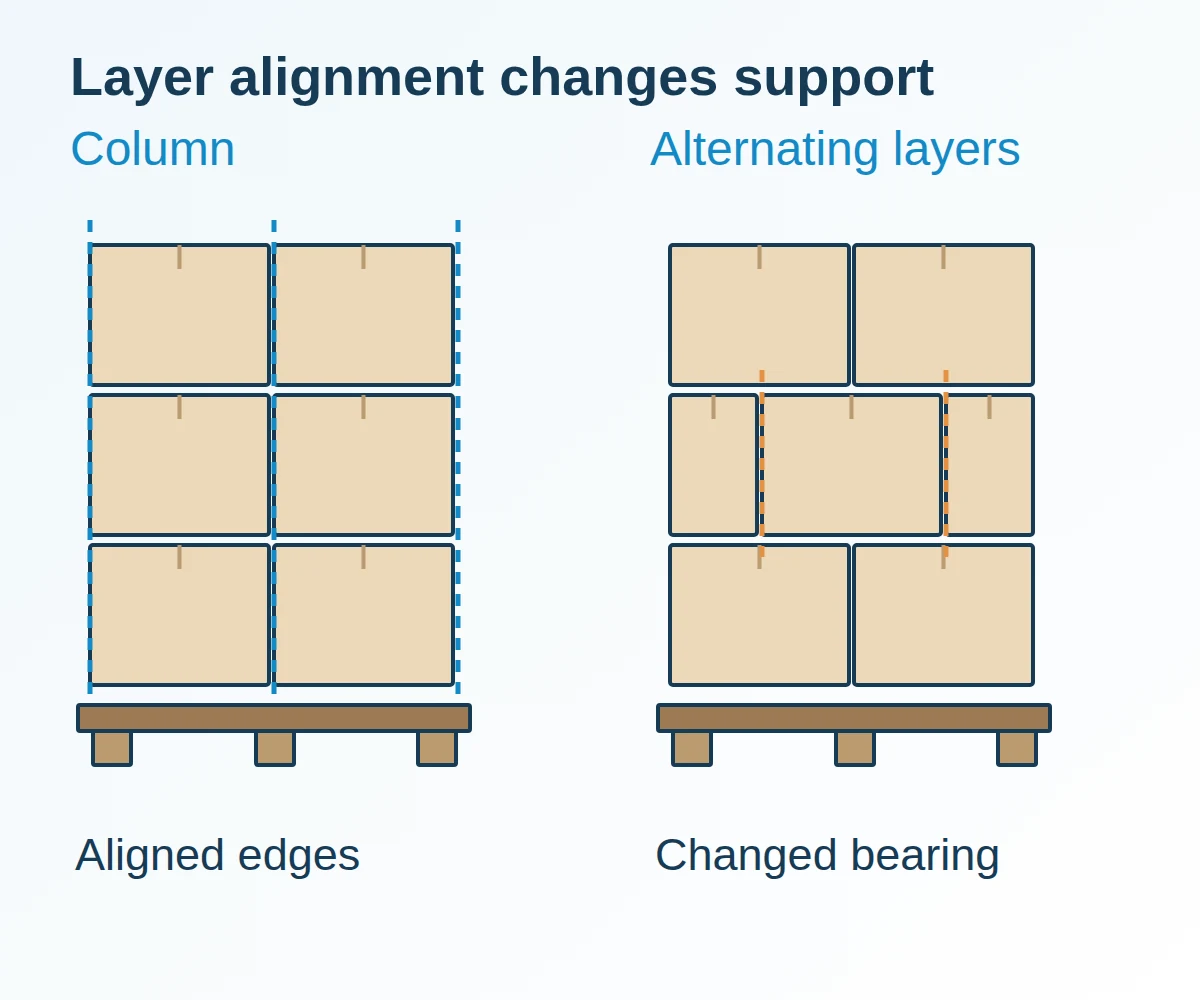
Choose warehouse pallet patterns by checking support and stability together. Repeated columns align cartons vertically; interlocked layers change the support beneath the next layer. Neither arrangement establishes a safe load by appearance alone. Record the actual carton, pallet, restraint and storage conditions, then evaluate that complete combination. A robot recipe should reproduce the accepted arrangement, including its orientation restrictions and edge positions, rather than optimize case count in isolation.
Start with the load record
Use the filled shipping case and the pallet’s actual support condition as the starting point. An empty-box drawing alone cannot describe bulging, closure variation or the way the packed product contributes to support.
| Input or item | Typical value or source | Why it matters |
|---|---|---|
| Case envelope and orientation | Measured packed-case dimensions; product handling instructions | Determines fit and permitted rotations |
| Pallet construction and condition | Approved drawing and inspection record | Identifies deck gaps and damaged support |
| Permitted load and storage method | Pallet manufacturer’s application-specific information | Floor, fork and rack support are different conditions |
| Storage exposure | Actual dwell time, temperature and humidity record | Package behavior can change during storage |
| Handling route | Recorded transfers, turns and receiving conditions | Defines the conditions the completed load must survive |
Complete all five input rows before releasing a new stacking recipe to production.
Compare the failure each pattern can introduce
Column stacking is a compression-oriented starting point for corrugated cartons; interlocking requires a fresh support review. XPO’s packaging guide, pages 4–5, favors precise column alignment and describes a carton-strength penalty from interlocking when the contents do not provide solid support. It also illustrates corner protection and load securement.
| Candidate arrangement | What to inspect | Dominant failure mode and prevention |
|---|---|---|
| Repeated columns | Alignment of successive case walls; lateral restraint | Separate columns can move relative to each other; evaluate the complete restraint arrangement through handling |
| Alternating or interlocked layers | Which upper-case edges bear on lower-case panels or joints | Changed bearing positions can concentrate loading; qualify compression in the actual pattern |
| Mixed orientations within a layer | Local support, product orientation and repeatability | A dense layer can conceal unsupported regions; retain a support drawing with the recipe |
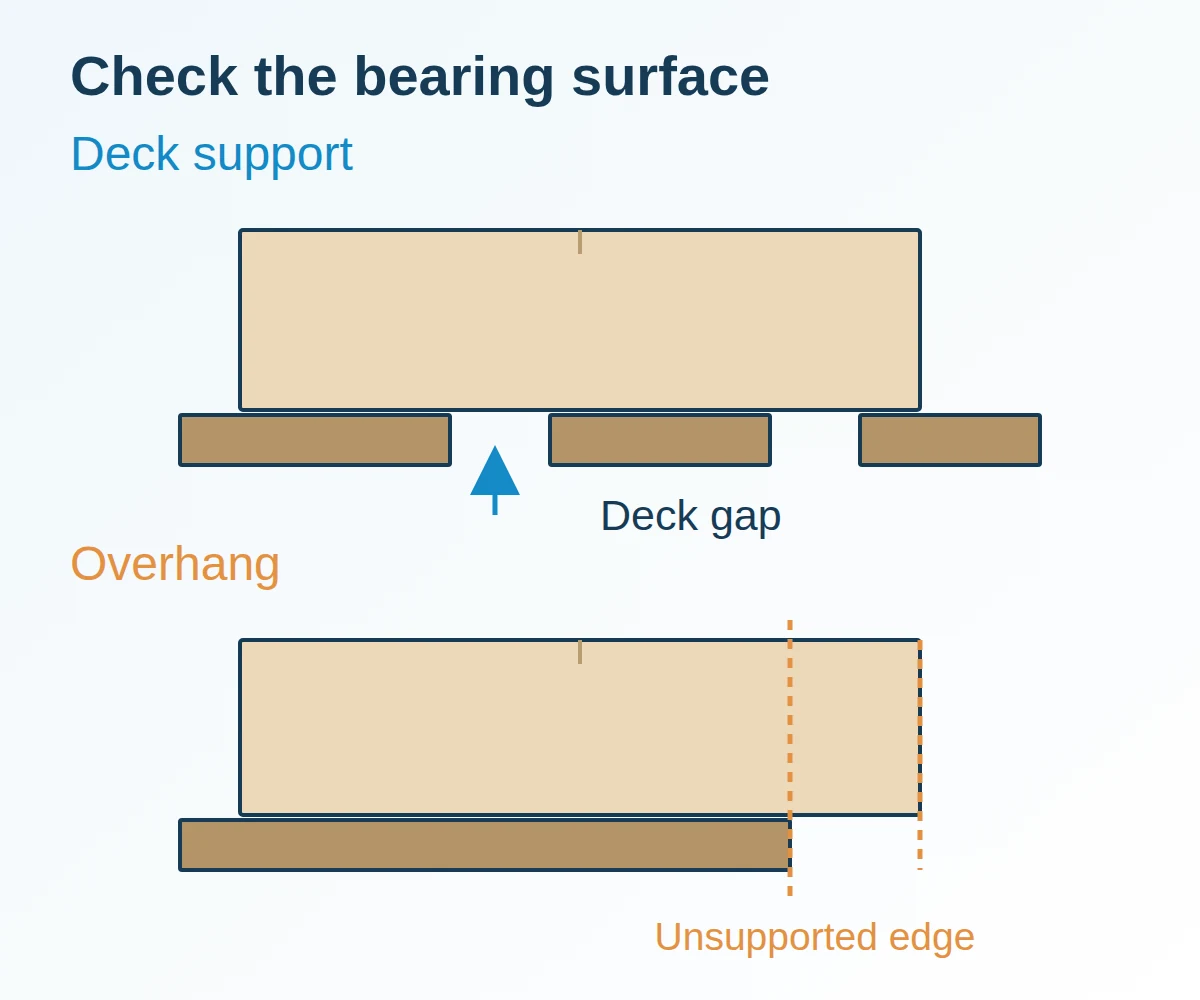
| Pattern with a projecting edge | Deck boundary beneath every outside case | Exposed or unsupported cartons can be damaged; revise the footprint before accepting the arrangement |
The Virginia Tech corrugated-box presentation, slide 37, treats pattern, misalignment, overhang and deck gaps as separate stacking-strength influences. Use that distinction diagnostically: carton crushing at a deck gap calls for a different correction from a whole column leaning during a turn.
Use height as a screening threshold
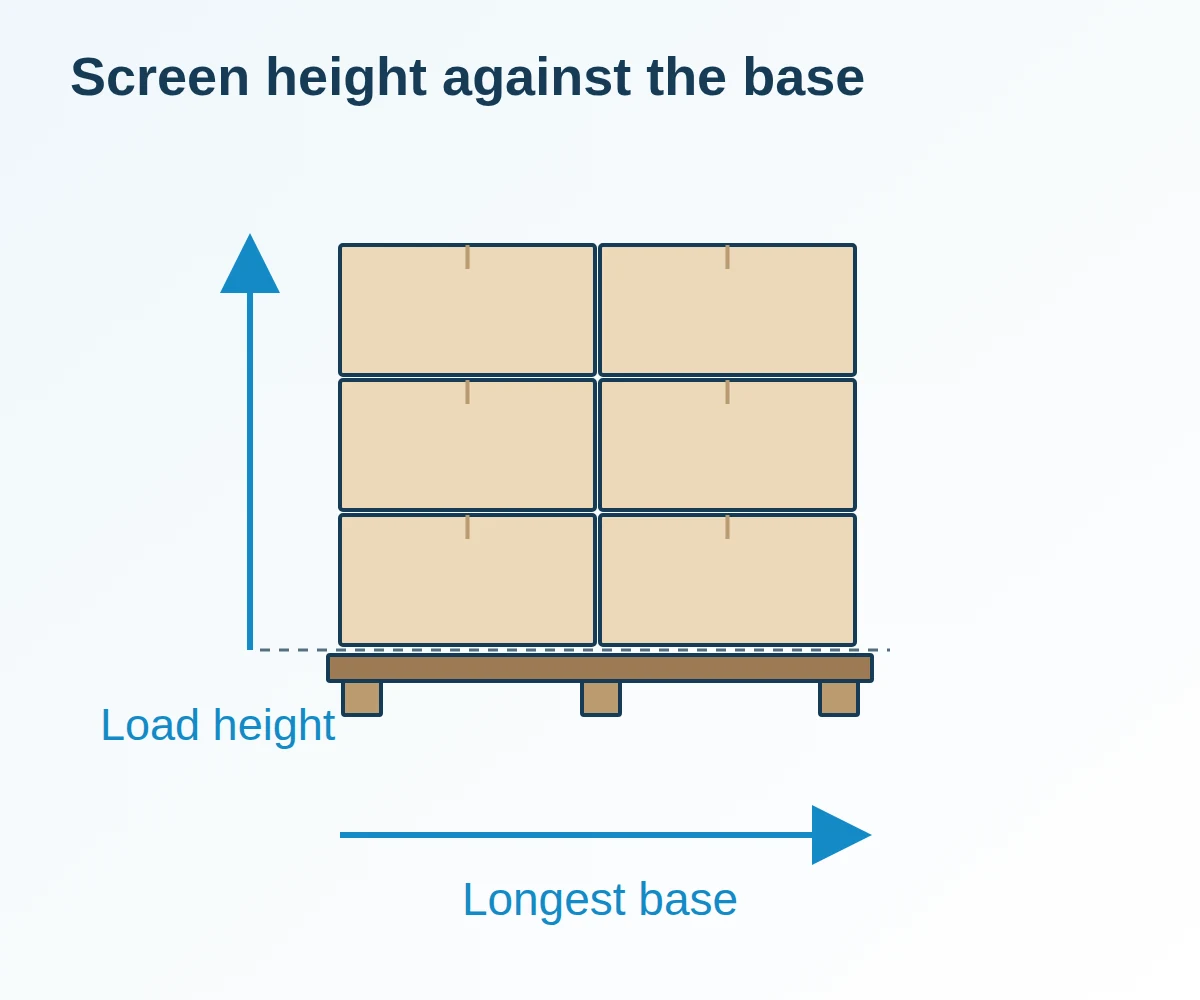
Load height needs an explicit review even when every case fits the pallet. HSE PM15, page 4, gives a general guide that load height should not exceed the pallet’s longest base dimension; it discusses restraint for taller loads and asks users to consider the payload and local conditions.
Physical threshold rule: if the load height exceeds the longest pallet base dimension, flag the arrangement for a specific stability and restraint review. Being below that threshold does not establish acceptance; being wrapped does not remove the need to assess the load.
For that initial screen, use:
H_screen = max(L, W)
Worked line: for the 1200 × 1000 mm UK pallet footprint mentioned in HSE PM15, page 2, H_screen = max(1200 mm, 1000 mm) = 1200 mm of load height.
Here H_screen is the guideline comparison height of the goods above the deck, not the overall pallet-plus-goods envelope. Stacking complete loaded pallets on one another requires a separate compression and stability assessment.
Release a pattern with evidence that can be repeated
An accepted pattern needs a revision record that links the physical arrangement to the handling conditions. Save photographs of the bottom layer, the completed unit load and the restraint arrangement alongside the case and pallet identifiers.
For a project review, make the acceptance record answer these questions:
- Does the bottom layer match the actual deck support, including gaps?
- Does each layer preserve the product’s permitted orientation?
- Which storage and handling conditions were included in the evaluation?
- What visible movement, deformation or damage triggers rejection?
- Which carton, pallet or restraint changes require the pattern to be reviewed?
For automated placement, also retain the gripper clearance and placement sequence. The robotic palletizing collection connects the load arrangement to cell integration; the palletization calculation guide screens geometry before that review.
Include rework and restraint in total cost
Compare total cost per accepted dispatched pallet, including cases lost, extra restraint material, inspection time, restacking labor and interrupted downstream time. A pattern that adds cases per layer can still cost more if it causes recurring rework. Record those costs against the same case and pallet revision so that unrelated product changes do not distort the comparison.
Use a ledger for one defined dispatch period, recording quantities and labor intervals in their native units:
| Ledger entry | Record and unit | Period calculation |
|---|---|---|
| Cases lost | Rejected cases, count | Sum cases lost against this load revision |
| Extra restraint | Additional film, m; additional bands, count | Total each material separately |
| Inspection labor | Inspectors and minutes per inspection | Sum inspectors × minutes, in person-minutes |
| Restacking labor | Events, workers per event and minutes each | Sum events × workers × minutes, in person-minutes |
| Line downtime | Start and restart timestamps, minutes | Sum non-overlapping stopped intervals |
| Accepted output | Dispatched pallets, count | Divide each period total by accepted pallets for a per-pallet comparison |
Worked period example: 3 restacking events × 2 workers per event × 5 minutes each = 30 person-minutes of restacking labor. When the same dispatch period records 9 minutes of line downtime, enter 9 line-downtime minutes on its dedicated row. Inspection time excludes time already logged as restacking, and overlapping stops count once.
Coordinate the restraint decision with the stretch-wrap and banding integration review, and include waiting and recovery at the palletizing conveyor handoff.
Technical basis and scope
This reference draws on UK Health and Safety Executive Guidance Note PM15 (Pallet safety, fourth edition), the XPO Freight Packaging Guide, and Virginia Tech / Pallet Design System stacking-strength criteria for corrugated boxes.