On this page
Choose stretch wrap or banding around the load’s restraint needs and the station’s place in the line. Define what must remain together during handling before comparing equipment or consumable use.

Define what banding means in your project
People use “banding” for several processes. This guide compares pallet stretch wrapping with narrow straps used to unitize a load. Paper bands around small product bundles represent a different task and should not be selected from this comparison.
Signode’s unitizing overview distinguishes strapping, wrapping and protective materials that may be used together. That is a useful starting point: the decision can involve both restraint methods where a load needs them. Neither method can be selected by pallet weight alone.
Compare the restraint at the package surface
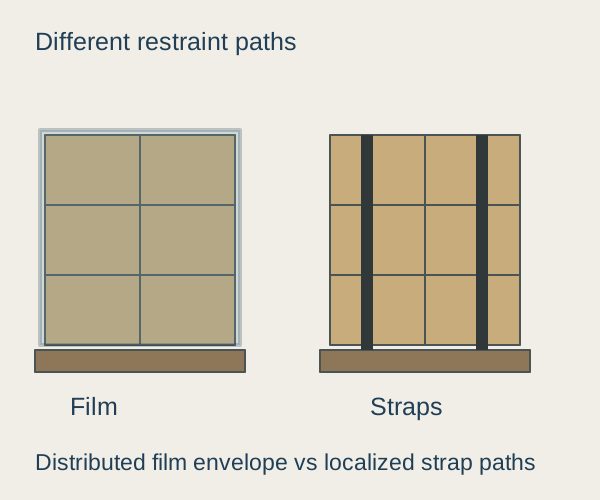
Stretch film surrounds the load and applies containment across the covered areas. Straps act along their paths, so contact at edges and corners deserves close attention. Check whether the outer cases can tolerate those local forces and whether protection is needed. Neither an attractive wrap nor a tight-looking strap proves the load will survive its distribution journey.

| Load question | Stretch-wrap review | Strapping review |
|---|---|---|
| Outer package sensitive to compression | Check film force and deformation on the actual load | Check edge loading and required protection |
| Load-to-pallet attachment needed | Define the wrapping method at the pallet base | Define strap routing and pallet access |
| Loose or irregular outer profile | Check film bridging, puncture and coverage | Check stable strap seating and contact points |
| Access needed after unitizing | Plan how film is removed or replaced | Plan strap removal and subsequent load handling |
| Existing protection already used | Assess interaction with corners, top sheets and labels | Assess guides, corner protectors and strap paths |
Validate the finished load rather than one setting
Lantech explains containment force as a load property to check with a defined measurement method. Its guidance includes checking different heights on the load and keeping the method consistent. A machine’s wrap-force setting and the number of revolutions are inputs; the resulting load still needs evaluation. See Lantech’s containment guidance.
For strapping, ask the selected supplier to define the strap, joint and applied-tension checks appropriate to the load. Do not convert a stretch-film containment reading into a strap-tension target. They describe different restraint arrangements and require their own methods.
Put the restraint station into the transfer sequence
A finished pallet must arrive in the position the station expects. Define its orientation, allowable overhang and the state of any loose material. Then identify what happens while the wrapper or strapper is unavailable. A loaded pallet waiting in front of the station can block the palletizer even when that robot has sufficient cycle capacity.
Treat replenishment and intervention as production events. Film changes, strap changes, broken consumables and rejected loads all need an agreed response. Include the destination of a load that cannot be accepted and the conditions under which upstream equipment may resume release.
Use a load qualification record
For each candidate method, retain the case and pallet identifiers, layer pattern, total height and mass, consumable identity and machine recipe. Add the inspection method and the distribution conditions the review is intended to cover. Keep initial appearance separate from the result after conditioning or handling.
Define acceptance before running the comparison. Examples of observations to record include visible case deformation, movement between layers, loss of load-to-pallet attachment and damaged restraint material. Document each of these physical criteria before and after simulated transport or lane trials. The selected transport evaluation must match your distribution risks.
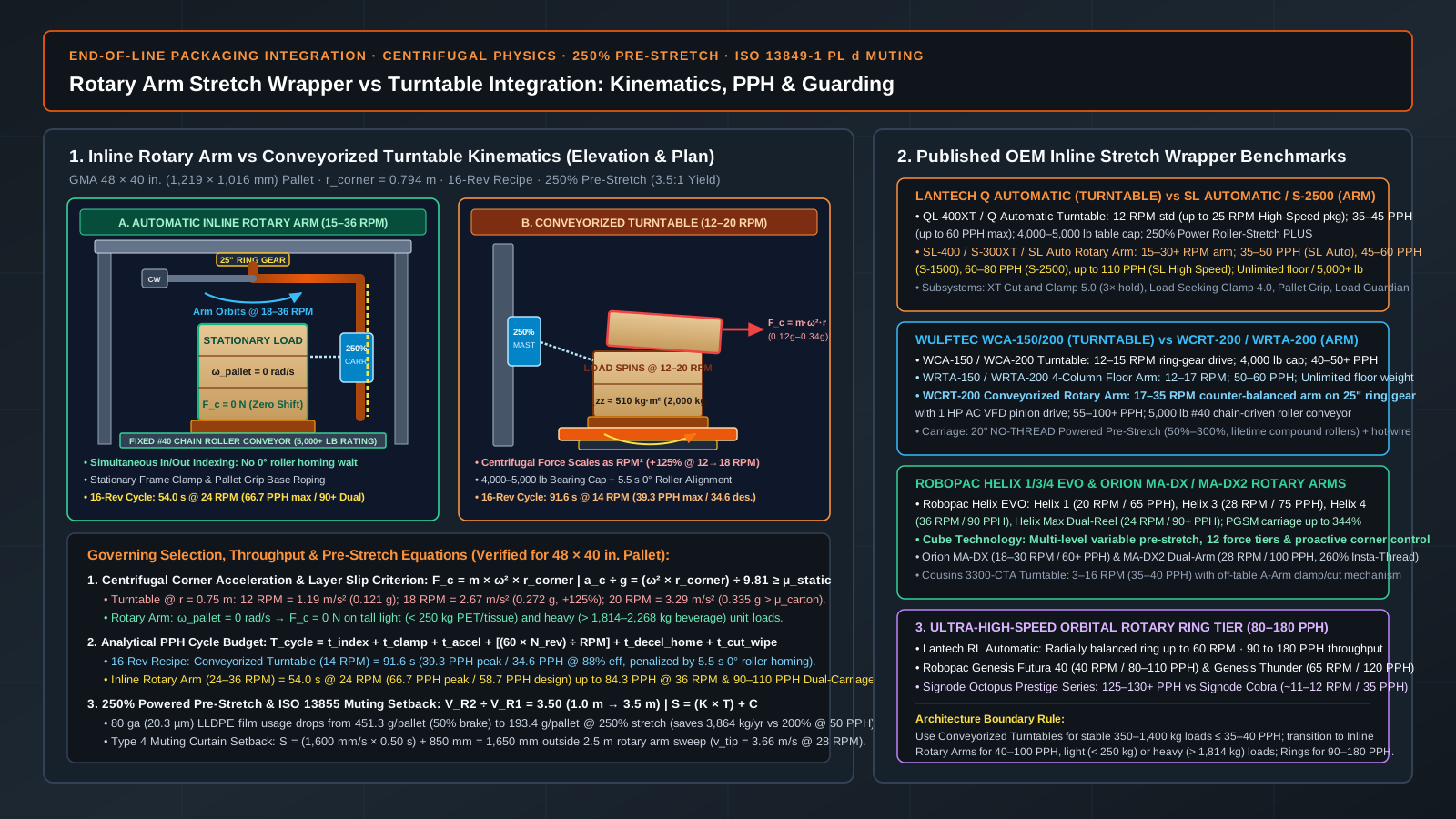
The packaging line integration collection places this choice alongside upstream grouping. Once stretch film is selected for the load, compare stationary-pallet overhead boom kinematics, 16-revolution PPH cycle budgets, 250% powered pre-stretch carriages, and muting light curtains in our rotary arm stretch wrapper vs turntable integration guide. Use the conveyor handoff record to assign the waiting and release behavior around the restraint station.
Technical basis and scope
This end-of-line restraint comparison draws on Signode’s unitizing systems documentation (strapping, stretch wrapping, and edge protection) and Lantech’s containment-force measurement methodology across load elevations. Reviewed October 2026.