On this page
- Quick Comparison of Slip Sheet Dispensers and Pallet Dispenser Machines
- Slip Sheet Dispenser Kinematics, Vacuum Porosity, and Double-Sheet Control
- Carriage Drives, Magazine Cartridges, and Placement Axes
- Vacuum Flow, Sheet Porosity, and Suction Cup Holding Force
- Pallet Dispenser Machine Mechanisms and Combined Infeed Sequencing
- Sheet Stiffness, Conveyor Roller Center Spacing, and Small-Package Support
- Lip Orientation, Push-Pull Forklift Handoff, and Load Transfer Stations
- Push-Pull Forklift Attachments, Load Unitization, and Truck Nameplates
- In-Plant Pallet to Outbound Slip Sheet Load Transfer Station
- Engineering Specification Checklist for Slip Sheet and Pallet Infeed Selection
- Sources
Selecting between a slip sheet dispenser and a pallet dispenser machine requires matching substrate thickness, vacuum cup flow, conveyor roller pitch, and downstream forklift attachments before misfeeds or transfer jams cause line downtime.
According to Apex Material Handling, slip sheets are several inches longer and wider than a standard pallet, cost 10% of the price of a pallet, weigh 5% of the weight of a pallet, and eliminate 4 in of height.
On the nVenia Hamer Brand Pallet Slip Sheet Dispenser, the dispenser will raise the stack magazine table after receiving a signal that a pallet is in place, one sheet is picked with suction cups, and a motor-driven carriage transports the sheet.
In MMCI Automation’s Quick-Ship Palletizer line, the QSP-100S model features a pre-positioned sheet hopper, or MMCI may outfit the cell with its SD-30 automatic sheet dispenser.
Quick Comparison of Slip Sheet Dispensers and Pallet Dispenser Machines
Evaluating published OEM specifications side by side clarifies how cycle rate, drive power, magazine storage, and substrate dimensions differ inside a robotic palletizing cell.
| Equipment Platform | Primary Infeed Role | Published OEM Specification |
|---|---|---|
| Slip Sheet Dispenser | Motorized sheet placement rate and stack height | On the nVenia Hamer Brand Pallet Slip Sheet Dispenser, the dispenser operates at 2 cycles/sheets per minute with a 1/3 hp TEFC motor and handles up to 48 in x 48 in sheets and up to a 10 in stack. |
| Slip Sheet Dispenser | Electrical power and compressed air demand | For the nVenia Hamer Brand Pallet Slip Sheet Dispenser, power requirements are 230/460VAC, 3 Ph, 1.56A/0.78A, and compressed air requirements are 15 CFM Maximum at 80 PSI. |
| Slip Sheet Dispenser | Supported sheet materials and thickness range | On the nVenia Hamer Brand Pallet Slip Sheet Dispenser, supported slip sheet materials are clean clay-coated paper, double-faced corrugated cardboard, cardboard, or plastic, with a minimum thickness of 32 mil (0.032 in) and maximum thickness of 250 mil (0.25 in). |
| Slip Sheet Dispenser | Magazine stack weight and height capacity | Under the nVenia Hamer Brand Pallet Slip Sheet Dispenser specification table, maximum size is 48 in x 48 in and capacity is approximately a 6 in stack up to 250 lb. |
| Sheet Inserter Options | Drawer sheet capacity and tab configurations | On TopTier Low Infeed sheet inserters, sheets are loaded into an 18 in capacity drawer with a capacity of 18 in of sheets and a sheet size less than 60 in in either dimension including 2, 3, or 4 tab models. |
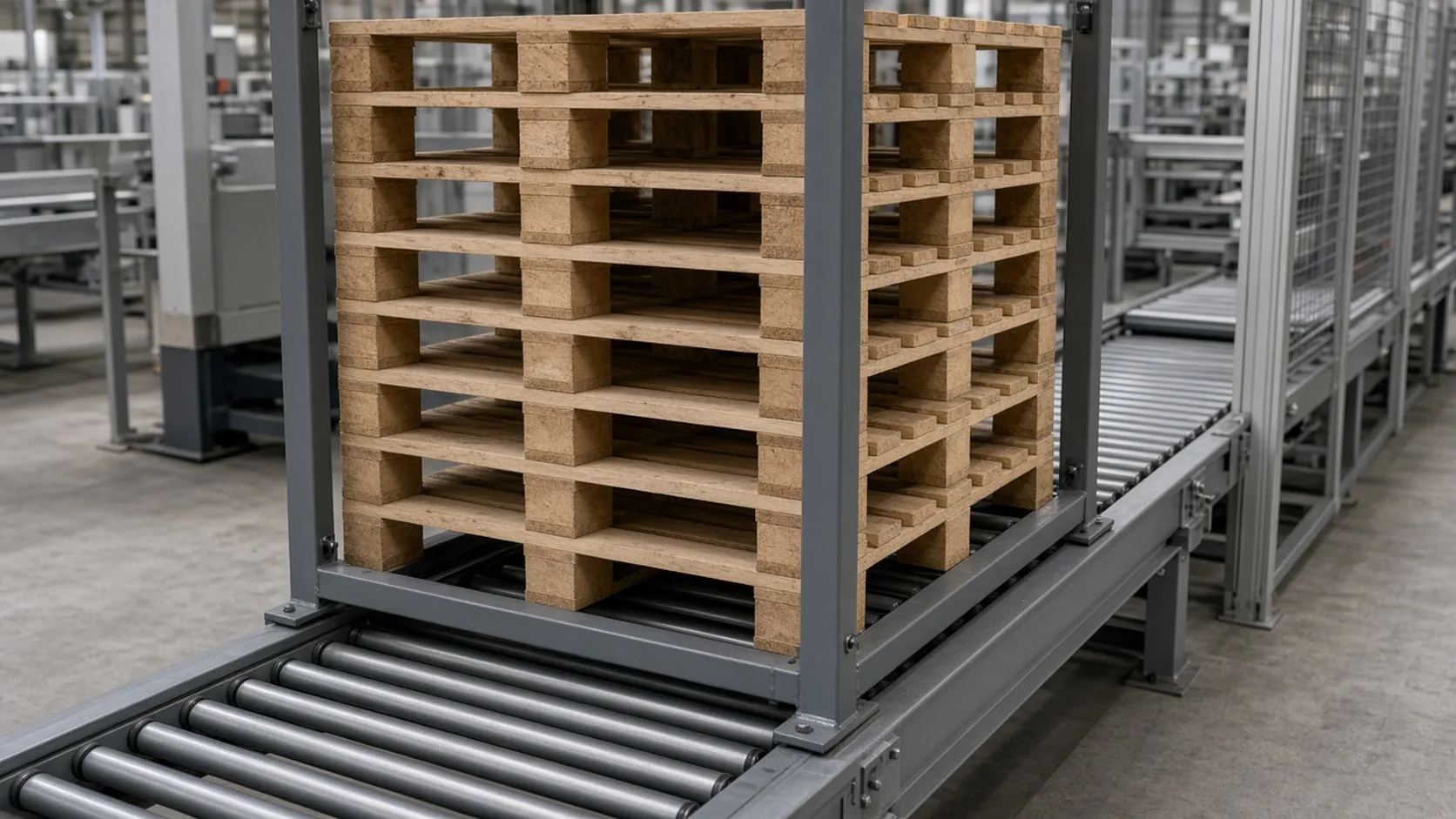
| Pallet Dispenser Machine | Side-capture dispensing for lower-grade pallets | The nVenia Hamer Brand Pallet Dispenser stores 15 empty pallets to dispense them in-line or at a 90-degree angle, and with air bag side capture, the Hamer Brand pallet dispenser works well with lower grade pallets and does not rely upon tabs. |
| Pallet Dispenser Machine | Lift motor horsepower, cycle rate, and air demand | The nVenia Hamer Brand Pallet Dispenser uses a 1.5 HP TEFC motor for fast, reliable pallet lift at 2+ pallets per minute, with 230 / 460VAC, 3 Ph and compressed air requirements of 10 CFM at 80 psi. |
| Pallet Dispenser Machine | Supported pallet entry types and dimensions | The nVenia Hamer Brand Pallet Dispenser handles 2 or 4-way GMA and CHEP pallet types with dimensions of width 30 in to 48 in, length 30 in to 48 in, and height 4.5 ft to 5.5 ft. |
| Electric Fork Pallet Dispenser | Multi-size pallet dispensing and stacking rate | In the Columbia Machine catalog, the electric fork pallet dispenser uses electric motor driven forks and lift carriage to dispense and/or stack up to 3 pallets per minute and accommodates a variety of pallet sizes with little or no adjustment. |
| Lift-and-Separate Dispenser | Fixed versus adjustable pallet entry styles | TopTier offers three different styles of pallet dispensing each with a lift and separate design and a 12 to 20 pallet capacity, including one design for 4-way entry 40x48 pallets only and designs that accommodate 2-way entry pallets. |
| Pallet Stacker and Dispenser | Holding fingers and dual chain discharge | Alba Manufacturing’s Pallet Stacker/Dispenser features an 8 ft high magazine with a 15 pallet capacity, is available at 90° or 180°, and includes pallet holding fingers and a dual chain conveyor that extends 2 ft 6 in beyond the frame at an 18 in conveyor elevation. |
| Inline Pallet Magazine | Pneumatic long-side and short-side pallet cycling | In the PALOMAT Inline brochure, the pneumatic unit handles pallets on the long side (1200/1219 mm) or short side (800/1000 mm) with a capacity (pallets/kg) of 15/500, a cycle per pallet of 10-15 seconds, and 55 litres of air used per cycle at 6-7 bar and 24V DC. |
| Combined Pallet and Sheet Line | Integrated pallet and slip sheet conveyor sequence | Tinsley Equipment Company’s combined line integrates an automatic pallet dispensing system (10 pallet capacity) and an automatic slip sheet applicator system (200 slip sheet capacity) with 6 foot length and 8 foot length conveyor sections. |
Slip Sheet Dispenser Kinematics, Vacuum Porosity, and Double-Sheet Control
Specifying a slip sheet dispenser requires coordinating carriage drive mechanics, magazine refilling access, and suction cup flow across porous paperboard and non-porous plastic sheets.
Carriage Drives, Magazine Cartridges, and Placement Axes
On the nVenia Hamer Brand Pallet Slip Sheet Dispenser, features include a 1/4 in structural tube steel frame, powder coat finish, bottom table pneumatic lift with flow control, a photo-eye sensor to detect sheet presence, and a low level indicator.
According to nVenia, a drive carriage that relies on pneumatics and rod-less cylinders requires bi-weekly adjustments to keep the carriage operating without speed variances.
On the nVenia HAMER Brand slip sheet dispenser, adjustable brushes are installed along the front of the magazine stack, and the vacuum of the pick and place cups can also be adjusted.
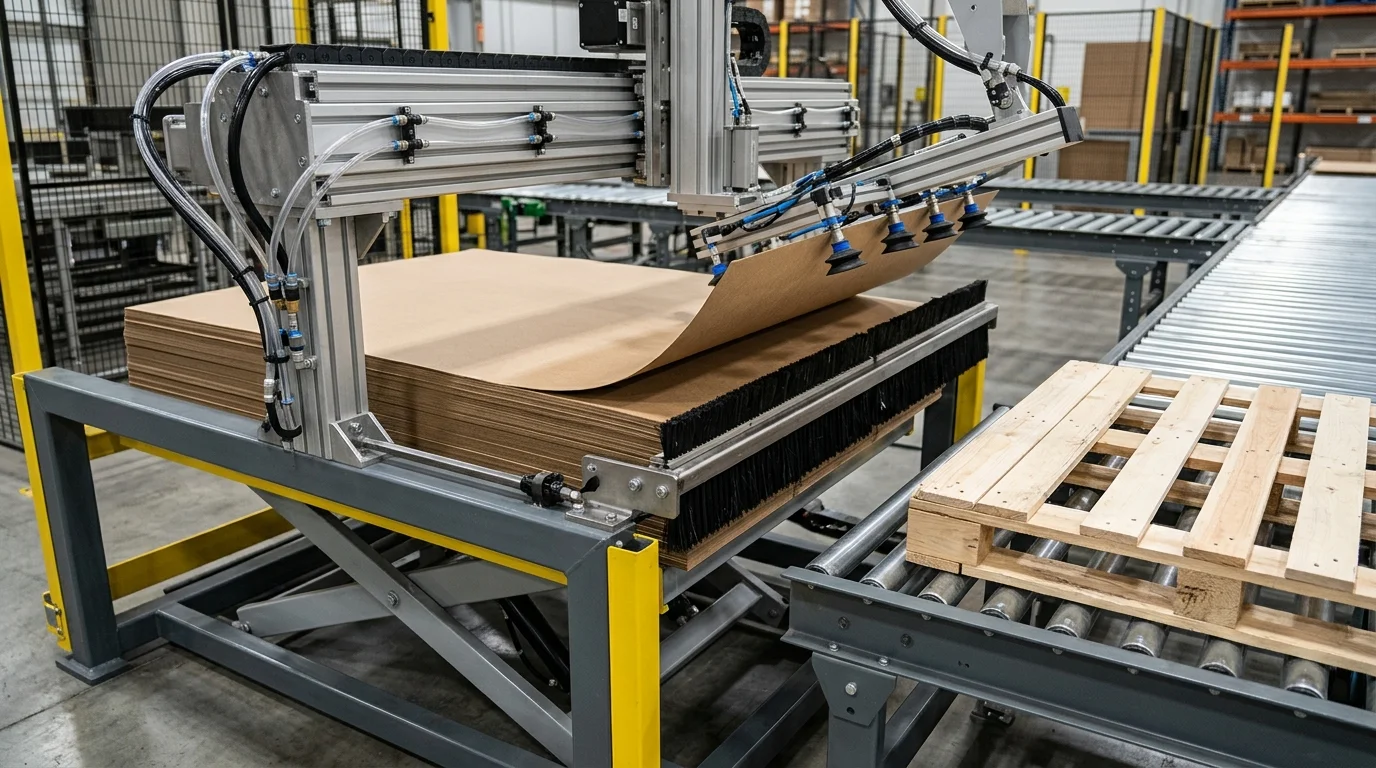
In the Columbia Machine modifications catalog, the 1097 Sheet Dispenser is used to place a slip sheet on staged pallets, whereas the 1098 Sheet Dispenser is used to place slip or tie sheets in a load and can also be used to place cap sheets.
In the Columbia Machine catalog, the 1091 Sheet Dispenser places a single size of sheet, either slip or tie, directly into the load building area on the FL1000, while the 597 Sheet Dispenser features motorized carriage travel.
For the Columbia 1098 Sheet Dispenser, the High Speed Sheet Placement modification uses a servo driven linear actuated arm that is heavy-duty and increases the speed of sheet placement.
In the Columbia Machine catalog, the Bulk Loading Sheet Dispenser allows the operator to place a pallet load of sheets onto the deck of a scissor lift that raises the sheets to the top.
In Columbia’s Sheet Cartridge Loading Option, 2 cartridges are included to allow the operator to fill the empty cartridge while the palletizer is still running with the 2nd cartridge on HL2000, HL4000, SP4000, HL6000, HL6200, HL7200, and HL9200 models.
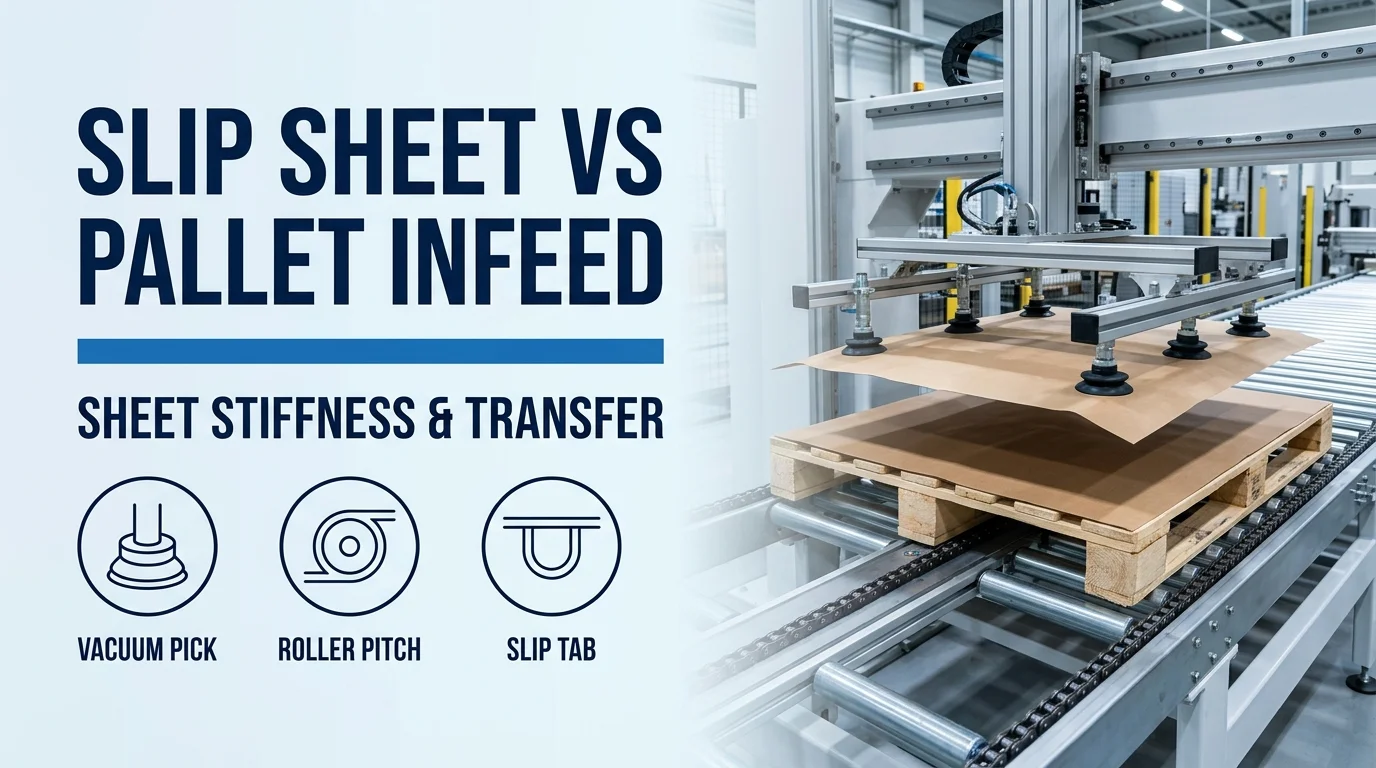
On TopTier palletizers, pallet liners are inserted with a horizontally travelling vacuum pick and place device, whereas slip sheets and top caps are inserted with a vertically and horizontally travelling vacuum pick and place device; tie sheet inserters can be equipped with up to three pick positions.
Vacuum Flow, Sheet Porosity, and Suction Cup Holding Force
Selecting vacuum generators and suction cups for sheet pick-and-place requires separating porous corrugated or paperboard media from air-tight plastic sheets.
According to Piab vacuum technology documentation, porous (leaking) materials allow air to pass through them, such as cardboard, fabric, or foam, which requires a vacuum system with a high flow rate, in contrast to non-porous (solid) materials.
In a decentralized vacuum system described by Piab, every suction point has its own dedicated vacuum pump, and if one suction cup cannot reach the target object, it does not affect the operation of the others.
In the Schmalz suction cup design guide, typical volume flow values are, for smooth air-tight surfaces, 0.5 m3/h (8.3 l/min) for diameters up to 60 mm (suction area 28 cm²) and 1.0 m3/h (16.6 l/min) for diameters up to 120 mm (suction area 113 cm²), with the instruction to conduct suction trials for porous parts.
In Schmalz suction cup design calculations using F = Δp x A, Schmalz recommends a safety factor (S) of at least 2, notes that the German accident prevention regulation UVV prescribes a binding safety factor of 1.5, and specifies 2.5 or higher when swiveling workpieces.
Pallet Dispenser Machine Mechanisms and Combined Infeed Sequencing
Where unit loads build on wood or plastic pallets—or where a slip sheet is placed as a bottom liner onto a staged pallet—the pallet dispenser machine governs upstream stack singulation and conveyor handoff. For stack mass limits and refill interval equations, see our pallet dispenser machine magazine sizing and infeed guide.
On the nVenia Hamer Brand Pallet Dispenser, frame construction includes a 15 pallet storage magazine, a 4 in structural steel tube frame, and 1/4 in structural steel cross braces.
In the Columbia Machine catalog, the bottom-feed chain drive pallet dispenser uses a powered chain drive system to feed a pallet from the bottom of the pallet stack to the load building area and has a capacity of 1200 Pounds (approximately 12 pallets).
In the Columbia Machine catalog, the lift and separate pallet dispenser uses a powered chain drive and hydraulic lift table system to feed the bottom pallet with a capacity of 1200 Pounds (12 pallets) and lists reduced pallet damage as a benefit; an electrically driven scissor lift option is listed for OK-1 and 703LS.
On Alba Manufacturing’s Pallet Stacker/Dispenser, the unit is Allen-Bradley MicroLogix PLC controlled and “Hand-shake” ready, is capable of stacking or dispensing a consistent pallet size, and requires that pallets must be in good condition.
In the PALOMAT Inline brochure, the electric unit has a cycle per pallet of 12-15 seconds and a capacity (pallets/kg) of 15/500, using SEW lifting motors at 2x380VAC/3P 1.2 Amp and supply voltage for SICK sensors and Linak gripper actuators at 24VDC 9 Amp.
Sheet Stiffness, Conveyor Roller Center Spacing, and Small-Package Support
Matching conveyor roller diameter and center-to-center pitch to the base substrate prevents small packages or flexible sheets from overhanging or catching between rollers across the palletizing conveyor systems interface.
On TopTier modular palletizing systems, frames are CNC formed of 1/4 in steel and sized for 60 in, 90 in, or 110 in load heights, and options include chain driven live roller conveyor, 3-strand drag chain conveyor, as well as guided shuttles.
| Conveyor or Modification Option | Roller Diameter & Chain Drive | Published Center Spacing & Load Specification |
|---|---|---|
| Close Center Rollers Kit | Driven 1.9 in and 1.375 in rollers and belts | In Columbia’s Close Center Rollers Kit, the kit includes 1.9 in and 1.375 in diameter rollers and belts where all rollers are driven, reducing the roll centers and allowing palletizing of smaller package types, as small as 4.25 inches wide. |
| Close Center Rolls Arranging Dual Chain | Assembled arranging conveyor rollers | For Columbia’s FL200 and FL500 models, the Close Center Rolls Arranging Dual Chain option for the assembled arranging conveyor uses rollers on 3.25 in centers to handle small product and handles small cases down to 4.25 in in width. |
| Heavy-Duty 1.9 in CDLR Conveyor | 1.9 in dia. x 12 ga. or 9 ga. with RC-40 chain | Alba CDLR conveyors with 1.9 in dia. x 12 ga. or 1.9 in dia. x 9 ga. rollers use RC-40 chain on 2-1/8 in DBS, 2-3/4 in, 4 in, or 6 in centers with a 7/16 in hex axle spring retained and effective widths up to 52 in. |
| Heavy-Duty 2-1/2 in CDLR Conveyor | 2-1/2 in dia. x 11 ga. with RC-40 or RC-60 chain | Alba CDLR conveyors with 2-1/2 in dia. x 11 ga. rollers and an 11/16 in hex axle up to 60 in offer centers of 2.75 in, 2.75 in DBS, 3.25 in, 3.75 in, 4 in, or 6 in with RC-40 chain, and 3 in DBS, 3.75 in, 4.5 in, 6 in, 9 in, or 12 in with RC-60 chain, at 30, 45, and 60 FPM. |
| Live Roller Case Conveyor | 1.9 in diameter x 16 ga. tread rollers | In Hytrol’s live roller case conveyor specifications, 1.9 in diameter x 16 ga. rollers on 3 in centers operate at 25-174 FPM with 37 lbs. per foot and 75 lbs. per zone in 18 in, 24 in, 30 in, or 36 in zones. |
| Chain-Driven Zero-Pressure Accumulation | 1.9 in x 16 ga. vs 2.5 in x 11 ga. rollers | In Hytrol’s chain-driven accumulation conveyor specifications, model 199-cre24ez uses 1.9 in diameter x 16 ga. rollers on 4 in or 6 in centers at a standard conveying speed of 28 FPM with a maximum unit load of 600 lbs. per zone, while model 25-cre24ez uses 2.5 in diameter x 11 ga. rollers with a maximum unit load of 1,300 lbs. |
Lip Orientation, Push-Pull Forklift Handoff, and Load Transfer Stations
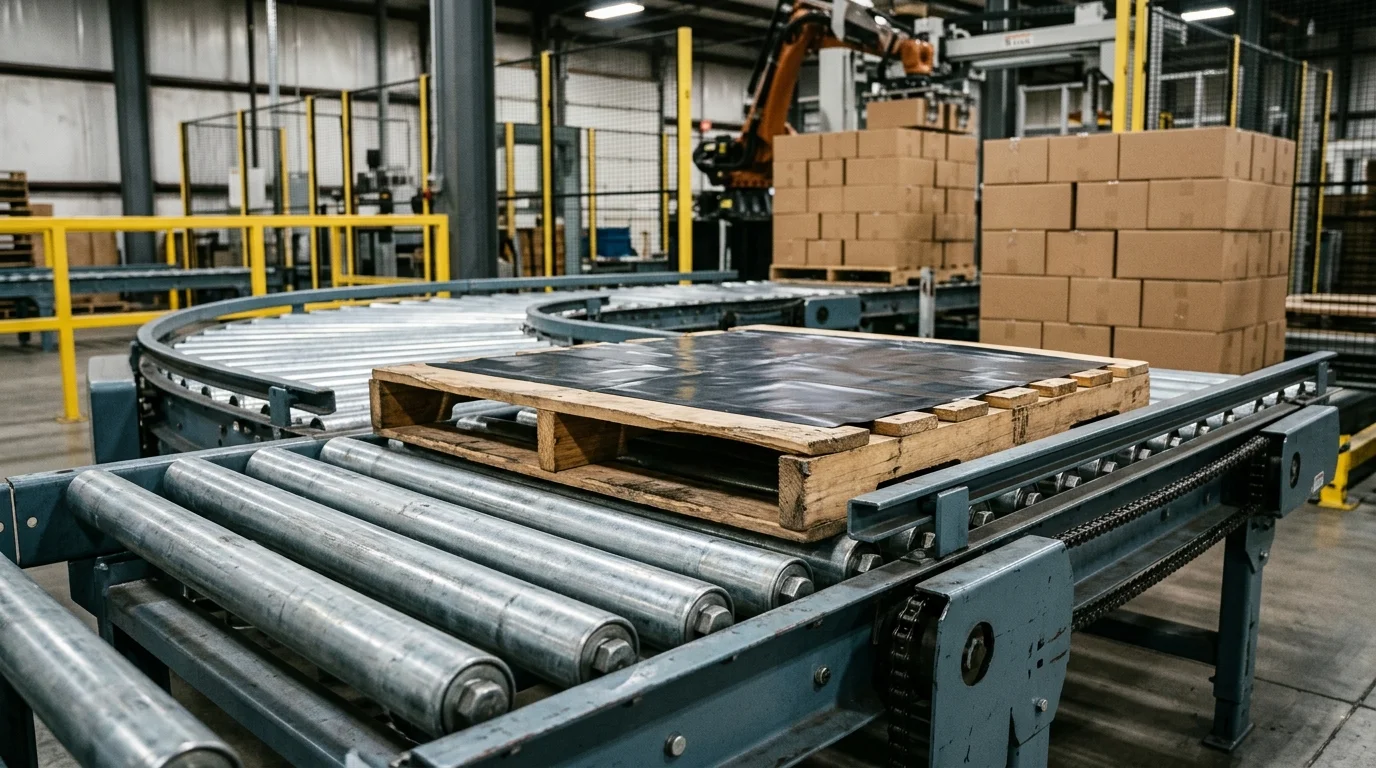
Downstream takeaway determines whether the slip sheet lip must face a forklift push-pull gripper at conveyor discharge or whether unit loads are transferred from plant pallets onto outbound slip sheets at a dedicated transfer station.
Push-Pull Forklift Attachments, Load Unitization, and Truck Nameplates
According to Apex Material Handling, handling slip sheets uses grippers to grab the sheet and platens, which are flatter than standard forklift forks, requires operators to strap, shrink-wrap, or stretch wrap the load, and notes that a push-pull attachment is heavy and will reduce lifting capacity.
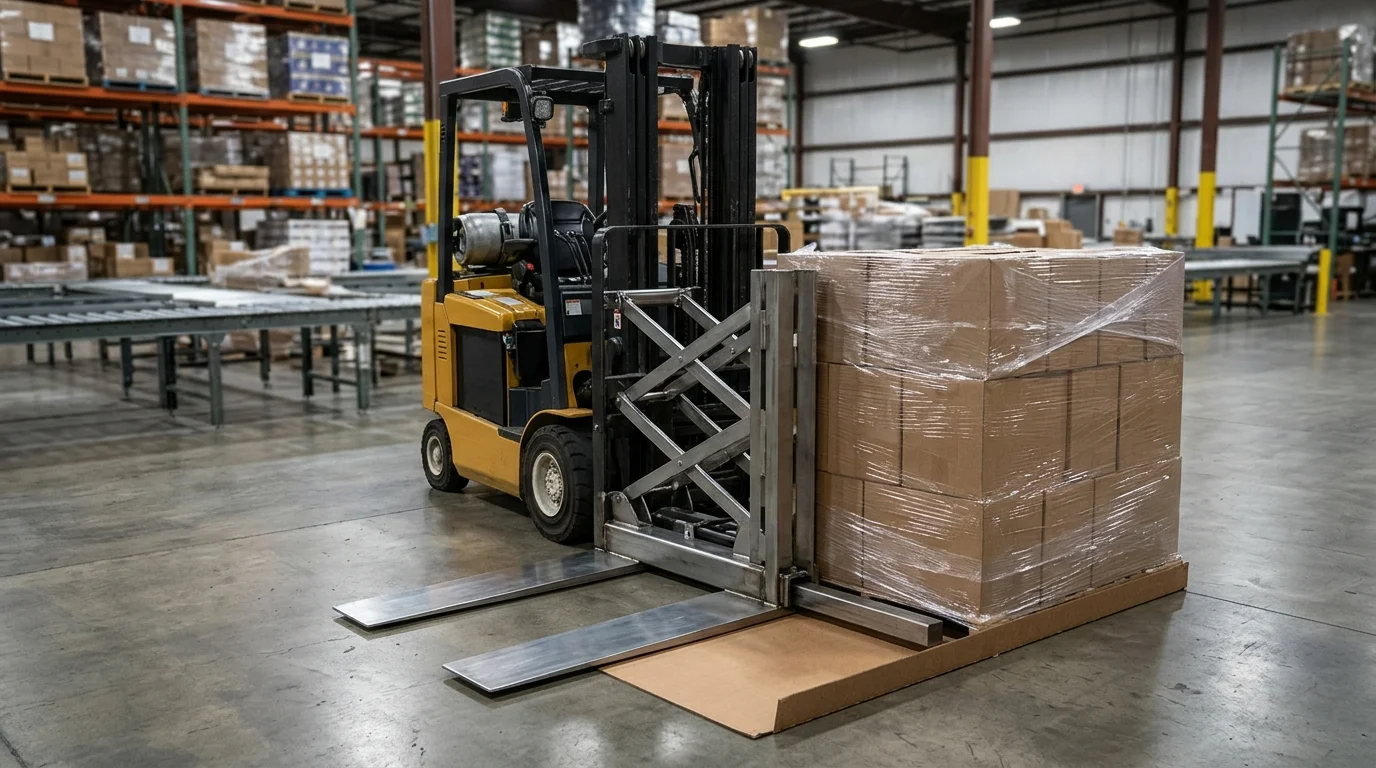
Under U.S. federal powered industrial truck regulations, modifications and additions which affect capacity and safe operation require the manufacturer’s prior written approval and capacity, operation, and maintenance instruction plates, tags, or decals shall be changed accordingly; if the truck is equipped with front-end attachments other than factory installed attachments, the user shall request that the truck be marked to identify the attachments and show the approximate weight of the truck and attachment combination at maximum elevation with load laterally centered.
In-Plant Pallet to Outbound Slip Sheet Load Transfer Station
On the Columbia Machine LTS-PD Load Transfer Station, the unit holds up to 20 pallets, features a 5 HP integral hydraulic power unit, weighs 10,000 lbs., has a 4,000 lbs. load capacity, and completes a cycle in less than 60 seconds inside a 234 in by 60 in footprint.
Engineering Specification Checklist for Slip Sheet and Pallet Infeed Selection
Before finalizing a slip sheet dispenser or pallet dispenser machine procurement specification, packaging engineers should document the following interface parameters:
- Record the sheet material composition, thickness envelope, and tab layout across all SKU recipes to confirm whether a horizontal pallet-liner dispenser or a multi-axis sheet inserter is required.
- Specify motor-driven pick-and-place carriage travel, front magazine separator brushes, and suction trials on actual porous paperboard or corrugated samples to verify single-sheet separation.
- Align the protruding slip sheet lip orientation in the magazine drawer or bin with the downstream forklift pickup direction at the takeaway conveyor.
- Compare conveyor roller center spacing across load-building and accumulation zones against the smallest container footprint and base support method.
- Confirm load unitization equipment, rack support platforms, and forklift manufacturer capacity plate updates where push-pull attachments replace wooden pallets.
Sources
- nVenia — Hamer Brand Pallet Slip Sheet Dispenser Product Documentation
- nVenia — Heavy-Duty Slip Sheet Dispenser Improves Palletizing Efficiency Technical Guide
- nVenia — Hamer Brand Pallet Dispenser Product Documentation
- Columbia Machine — Palletizer Modifications and Accessories Catalog
- Columbia Machine — Load Transfer Station with Pallet Dispenser Cutsheet
- TopTier Palletizers — Palletizer Options and Modular Palletizing Systems Documentation
- Alba Manufacturing — Pallet Stacker Dispenser and Chain-Driven Live Roller Conveyor Product Specifications
- Hytrol Conveyor Company — Low-Voltage Live Roller and Zero-Pressure Accumulation Conveying System Brochure
- PALOMAT — Inline Pallet Magazine Product Brochure
- Piab — Automation by Vacuum Technology Documentation
- Schmalz — Design of the Suction Cup Technical Knowledge Guide
- Apex Material Handling — Forklift Handling and Storage Tips for Slip Sheets
- MMCI Automation — Robotic Slip Sheet Dispensing Documentation
- Tinsley Equipment Company — Automatic Pallet Dispenser with Slip Sheet Applicator Documentation
- United States Department of Labor / Electronic Code of Federal Regulations — Powered Industrial Trucks Safety Regulation